G.L.A. INVE$T RE$EARCH
THE INFINITE INNOVATION NEWSLETTER — PRE-IPO WEEKLY
Why d-Matrix Is a Must-Watch Pre-IPO AI Infrastructure Opportunity

Happy Wednesday to all of the G.L.A’s reading this, I wanted to talk to you today about what I think will become a great investment over the next year or two. d-Matrix is one of the most compelling private AI-infrastructure companies we are tracking today. We believe its differentiated inference architecture, move into full production, strategic partnerships, and potential paths to either an acquisition or IPO make it a high-conviction name for qualified pre-IPO investors to watch.

This is not a “Nvidia is finished” thesis. Nvidia remains the dominant AI-compute platform. Our thesis is that the AI industry is entering a new phase where inference—not training—is becoming increasingly important, and where the winning data center may use multiple types of silicon rather than GPUs alone.
The AI Inference Shift
Training large AI models requires enormous compute. But inference is where those models become products: every prompt, AI-agent task, generated token, customer-service interaction, voice response, and coding request consumes inference capacity.
That creates a massive economic opportunity for companies that can reduce latency, energy use, and cost per generated token.
GPUs are extraordinarily capable and will remain essential for many AI workloads. However, they are general-purpose parallel-compute systems. As AI applications become more real-time and interactive, specialized hardware can be better suited for specific portions of the inference stack.

d-Matrix is built for this opportunity.
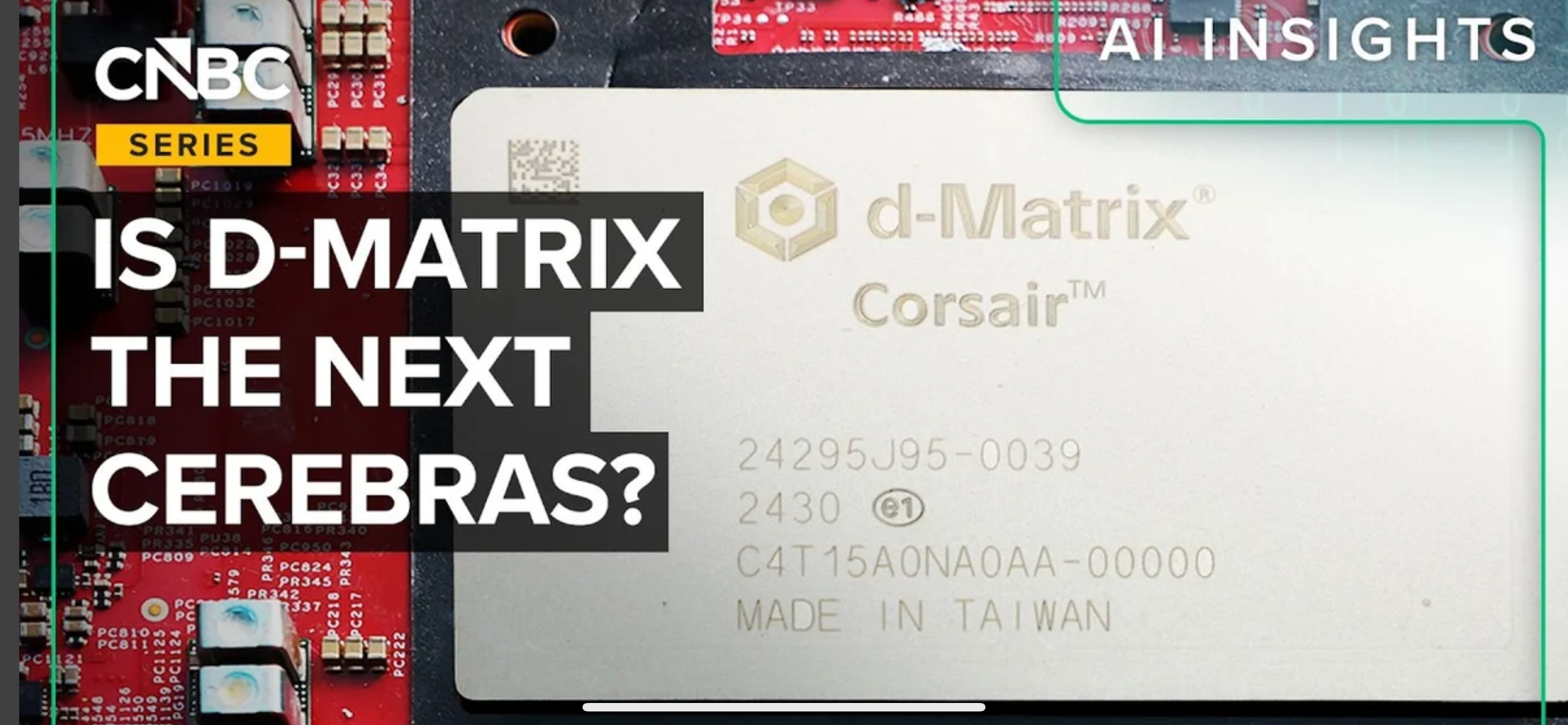
The company’s Corsair platform pairs custom inference accelerators with GPUs in a heterogeneous architecture. Rather than demanding that customers replace their GPU investments, d-Matrix is positioning itself as an accelerator that can help make GPU-based AI infrastructure faster, more efficient, and more economical.

Why Corsair Matters
Corsair is d-Matrix’s AI-inference platform, built around Digital In-Memory Compute architecture. The design integrates SRAM memory closely with compute, reducing the costly and energy-intensive movement of data between processor and memory.
This is important because memory bandwidth is one of the central bottlenecks in AI inference.
d-Matrix says Corsair can deliver substantial benefits in heterogeneous systems that pair its accelerators with GPUs:
Metric | d-Matrix claimed performance |
|---|---|
Inference speed | More than 10× faster |
Cost efficiency | Approximately 3× cheaper |
Energy efficiency | Up to 5× more efficient |
Key applications | Coding agents, voice AI, chatbots, video generation, and agentic AI |
These figures are company claims based on specific configurations and workloads—not universal benchmarks. Real-world results will depend on the model, software stack, workload, networking, and customer deployment. But the magnitude of the claimed improvement is meaningful enough that the market should pay close attention.

Corsair has now moved beyond the prototype stage. d-Matrix announced that the platform entered full production in June 2026, with manufacturing through TSMC and Alchip on TSMC’s N6 node. The company has cited multi-year supply and fabrication arrangements intended to support volume demand.
Why We Are Bullish
Inference could become AI’s largest compute market
The value of a trained model is unlocked only when users and enterprises actually run it. Unlike training, which occurs periodically, inference is recurring. Every deployed AI assistant, enterprise copilot, consumer chatbot, and autonomous agent becomes a continuing compute workload.
Latency is especially critical for coding agents, interactive enterprise assistants, voice systems, and real-time agentic applications. If an AI tool responds slowly, the user experience breaks down. Fast, economical inference is not a luxury—it is a prerequisite for wide-scale adoption.

The future is heterogeneous compute
The market is beginning to move beyond a simplistic “which chip beats the GPU?” question.
Different chips can be optimal for different workloads. GPUs are likely to remain the central compute platform of the AI era, but specialized accelerators can improve the economics and performance of targeted tasks. That is why we believe the real opportunity is increasingly GPU plus accelerator, rather than GPU versus accelerator.
d-Matrix’s system-level approach is designed for that environment. Its SquadRack reference platform integrates Corsair accelerators, Aviator software, JetStream networking, and infrastructure partnerships with Arista, Broadcom, and Supermicro.
Full production is an important milestone
There are many impressive AI-chip presentations. Far fewer companies successfully manufacture hardware, build the required systems and software stack, secure supply, and ship into real customer environments.

Corsair entering full production materially reduces one of the biggest risks facing hardware startups: the transition from technical promise to commercial execution. d-Matrix has indicated demand from hyperscalers, neoclouds, and leading AI labs, although it has not publicly named those customers.
Strategic capital and validation
d-Matrix’s November 2025 Series C valued the company at approximately $2 billion. The financing included M12, Microsoft’s venture arm, alongside Temasek, Mirae Asset, Industry Ventures, Berkeley Frontier Fund, and other investors. Forge reports total company funding of roughly $429 million.
Microsoft’s investment does not guarantee commercial adoption, an acquisition, or any preferred relationship. But it is notable that M12 invested in a company focused on solving inference challenges while Microsoft itself is building custom AI infrastructure and operating AI services at extraordinary scale.
Two Potential Paths to Liquidity

We see two credible potential paths to value creation for d-Matrix investors: a strategic transaction or a successful IPO. Neither should be assumed, and both depend on operational execution.
Potential strategic acquisition target
d-Matrix could become a strategically valuable target for a larger AI-infrastructure company seeking specialized inference IP, a production-ready accelerator platform, lower-latency AI capability, and access to the rapidly growing inference market.
The most relevant recent precedent is Groq. In late 2025, Nvidia entered into a transaction reported at approximately $20 billion involving Groq’s AI-chip assets and inference technology, while bringing key Groq personnel into Nvidia. Importantly, it was not a conventional acquisition of Groq’s entire corporate entity: Groq characterized the agreement as non-exclusive licensing of its inference technology, while continuing its GroqCloud business independently.

The message for private-market investors is clear: differentiated inference technology can command strategic value when AI leaders believe it can expand their platform, protect their competitive position, or accelerate time to market.
d-Matrix has qualities that could be strategically attractive:
A differentiated digital in-memory compute architecture.
A product that has entered full production.
A complementary position alongside GPU infrastructure.
An expanding system, networking, and software stack.
Exposure to the most latency-sensitive AI workloads.
The company has also moved to broaden its rack-scale capabilities through the acquisition of GigaIO’s data-center business, adding systems-engineering and interconnect assets to its broader inference platform.
We are not predicting that Nvidia—or any other company—will acquire d-Matrix. However, the Groq transaction shows that large incumbents are willing to spend aggressively for scarce, specialized inference technology.
Potential successful IPO
The other potential path is a public-market outcome comparable to Cerebras.
G.L.A. INVE$T RE$EARCH made its Cerebras investment in late 2024, when Cerebras was approximately a $2.9 billion company—within the same general valuation range as d-Matrix today. Forge reported Cerebras’ September 2024 financing at around a $2.9 billion valuation.
Cerebras completed its IPO in May 2026 at $185 per share, and the stock closed its first trading day at $311.07 per share. As of today $CBRS is trading above $250.
Our Cerebras investment is now up more than 13×. That figure reflects our own entry price, ownership structure, dilution, and current or realized position value. It is a report of our experience—not a promise, forecast, or implication that d-Matrix will deliver a similar result.
Cerebras and d-Matrix are not identical businesses. Cerebras uses a wafer-scale architecture and has followed its own distinct commercial path. But the comparison is relevant because both companies represent differentiated approaches to AI compute beyond conventional GPU-centric infrastructure.
Cerebras demonstrated that public investors can reward companies with real technical differentiation, a credible AI-infrastructure narrative, and exposure to accelerating demand for alternative AI-compute architectures. Cerebras’ IPO debut was one of the defining AI public-market events of 2026.
Our view: At an approximately $2 billion private valuation, d-Matrix may offer investors exposure to a company at an earlier stage of a potentially similar value-creation journey—provided it can execute commercially.

Coach Kyle’s Bottom Line
We believe d-Matrix represents a compelling pre-IPO opportunity because it is aligned with one of the most important shifts in AI: the move from a training-dominated market toward a massive, recurring, latency-sensitive inference market. I also love the size of the company around 2.5 billion, still has a lot of meat on the bone for potential investors.
Corsair’s transition into production is a major milestone. The company’s strategy of augmenting GPUs rather than trying to eliminate them is pragmatic. Its strategic investor base, systems partnerships, and potential to become either a key independent AI-infrastructure platform, a strategic acquisition target, or eventually a public company all support the long-term opportunity.
The upside case is substantial—but this remains a speculative, high-risk private investment. For qualified investors who understand the risks of illiquidity and can tolerate a long investment horizon, d-Matrix belongs near the top of the AI-infrastructure pre-IPO watchlist.

Disclosure: This newsletter is for informational and educational purposes only and does not constitute investment advice, an offer to sell securities, or a solicitation to buy securities. Private-company investments are speculative, illiquid, and may result in the total loss of capital. Past performance, including G.L.A. INVE$T RE$EARCH’s reported Cerebras return, is not indicative of future results. Conduct independent due diligence and consult qualified legal, tax, and investment professionals before making any investment decision.