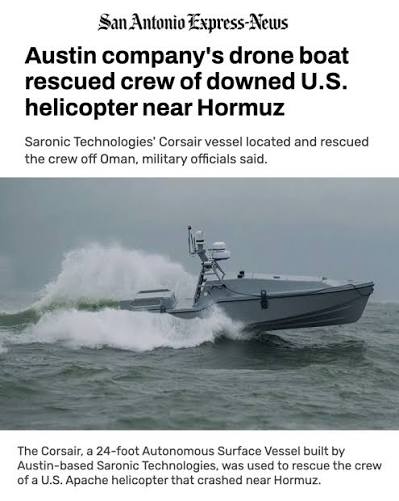
Private Market Spotlight Overview: Saronic
G.L.A INVE$T RE$EARCH – The INFINITE INNOVATION NEWSLETTER

Invest In The Best, Ignore The Rest, Welcome To G.L.A INVE$T!
Happy Thursday to the Greatest Living Americans! Today we are doing a Private Market Stock Spotlight on Saronic, a defense‑tech company redefining naval power projection through autonomous, software‑defined ships.
We currently view Saronic as:
One of our favorite pre‑IPO companies in the defense autonomy stack.
A strategic asset that could ultimately be a natural M&A fit for Anduril, given overlapping missions in autonomous defense systems, AI‑driven sensing, and software‑centric hardware.
What Saronic Builds and Problems They Solve

Saronic designs and manufactures fully autonomous surface vessels like Corsair, a 24‑foot high‑endurance, unmanned speedboat used by the U.S. Navy in one of the first autonomous rescue missions in the Strait of Hormuz.
Key problems they address:
Human risk in contested waters: Corsair has already demonstrated the ability to rescue downed pilots without putting additional soldiers in harm’s way.
U.S. shipbuilding capacity gap vs. China: The U.S. currently builds ~100,000 gross tons of ships annually, versus ~23 million gross tons in China—a ~230:1 production gap. Saronic focuses on scalable, attritable autonomous fleets that can be produced faster and cheaper than traditional manned vessels.
Cost and complexity of crewed ships: Traditional ships embed significant cost, volume, and complexity to support humans (beds, electrical systems, doors, bathrooms, stairways, etc.). Saronic’s autonomous designs strip out human‑support infrastructure, allowing:
Longer range (Corsair can reach ~1,000 nautical miles, versus typical 24’ commercial boats that cannot).
Higher performance and controllability.
Lower unit cost and simpler maintenance.
Persistent maritime domain awareness and deterrence: Autonomous fleets enable continuous monitoring, patrol, and rapid response over large ocean areas with fewer personnel and lower marginal cost.

TAM, Moat, and Strategic Positioning
Total Addressable Market (TAM)
While exact numbers require a full bottoms‑up model, the broad TAM vectors are clear:
Defense maritime autonomy: U.S. Navy and allied navies shifting toward smaller, distributed, and autonomous platforms for ISR, ASW, surface warfare, and logistics.
Commercial security and infrastructure: Ports, energy infrastructure (offshore platforms, pipelines), and choke points (e.g., Hormuz, South China Sea) needing persistent, autonomous surveillance and response.
Global shipbuilding modernization: As legacy shipyards struggle with cost, labor, and regulatory burdens, software‑first builders that can deliver modular, standardized autonomous vessels capture incremental share.
Given China’s 57% share of global shipbuilding capacity and the U.S. Navy’s statutory target of 355 ships (versus ~296 today), Saronic’s addressable spend sits in a rapidly expanding budget category focused on autonomous, attritable mass rather than a few ultra‑expensive platforms.paste.txt
Moat
We see Saronic’s emerging moat along several dimensions:
Operational proof with U.S. Navy: Being trusted to execute a first‑of‑its‑kind autonomous rescue in an active conflict zone is a strong validation of reliability and mission‑critical performance.
Founder/operator pedigree: Leadership with 11 years in the Navy SEAL teams and prior experience at Anduril brings unique domain knowledge, deep user empathy, and strong credibility with defense customers.
Full‑stack autonomy architecture: Saronic optimizes naval architecture, propulsion, control systems, and autonomy software as a single integrated product, rather than bolting autonomy onto legacy hulls.
Cost‑performance optimization: By designing ships without human‑support subsystems, they achieve superior range, speed, and payload economics per dollar and per ton compared to traditional craft.
Cultural and brand narrative: Names like Corsair and “Saronic” (from the Saronic Gulf near Athens, site of the pivotal naval Battle of Salamis where smaller, more maneuverable ships defeated a larger fleet) reinforce a strategic identity: winning through agile, numerous, autonomous craft rather than a few big ships.

For Accredited Investors Who Are Interested In Saronic, Contact me.
Secondary Market Pricing and Growth
In the private secondary markets, we’ve observed: HIIVE / FORGE / EQUITY ZEN ? NOTICE / CAPLIGHT
Consistent upward repricing: Investor demand for high‑quality defense autonomy plays has driven meaningful appreciation in available secondary blocks, with Saronic’s implied valuation stepping up across recent indications of interest.
Tight float and illiquidity premium: Limited secondary supply, combined with strong institutional and strategic holder bases, has contributed to higher clearing prices versus earlier rounds.
Defense‑tech re‑rating: The broader re‑rating of defense and dual‑use autonomy names (in both public and private markets) supports continued secondary price momentum, particularly for companies with validated military deployments like Saronic.

Notable Backers and Strategic Relationships
Without disclosing non‑public details, we can highlight the type of backing that strengthens Saronic’s case:
Tier‑one defense‑oriented venture capital: Backers with track records in companies like Anduril, Palantir‑adjacent ecosystems, and national security AI.
Strategic defense and government relationships: Direct collaboration with the U.S. Navy for operational deployments and experiments, as evidenced by the autonomous rescue mission in Hormuz.paste.txt
Founder’s Anduril history: The CEO previously worked at Anduril, which positions Saronic within a network of leading defense autonomy companies and makes a future combination strategically natural.paste.txt
Potential Path to Exit

We see multiple credible exit vectors:
Strategic acquisition (base case)
Anduril combination: Given overlapping cultures (software‑defined hardware, autonomy, mission‑first), prior employment links, and complementary product fit (Anduril’s sensor and command‑and‑control stack + Saronic’s autonomous vessels), a merger or acquisition is a clear and compelling scenario.
Other defense primes: Traditional primes seeking to modernize and “buy” autonomy talent and architectures could also be acquirers, particularly if Saronic’s fleet scales into key mission profiles (ISR, ASW, anti‑surface, logistics).
IPO / De‑SPAC (longer‑dated option)
As revenues scale with multi‑year Navy/allied contracts and international customers, a defense‑tech IPO becomes viable, especially in an environment increasingly friendly to national security plays.
Roll‑up into an autonomous systems platform
Saronic could be a cornerstone asset in a larger autonomous defense platform—combining air, sea, and land autonomy under a single brand, with Saronic owning the maritime domain.
In our view, the Anduril merger path is a realistic and attractive route: Anduril acquires a battle‑tested maritime autonomy layer, Saronic gains scale, distribution, and capital, and the combined entity offers a full‑spectrum autonomous deterrence stack.

Why Saronic Is One of Our Favorite Pre‑IPO Names
Coach Kyle’s 2 Cents:
They solve real, urgent national security problems—reducing human risk and closing the U.S. naval capacity gap with scalable autonomous fleets.
They have already proven capability in live operations, not just demos.paste.txt
Their unit economics, autonomy architecture, and founder pedigree create an emerging defensible moat.
Secondary market pricing trends reflect growing, not fading, institutional conviction in defense autonomy.
The path to exit—particularly via a potential merger with Anduril—offers a clear strategic narrative and multiple upside scenarios.
