G.L.A. INVEST RESEARCH — The Infinite Innovation Newsletter
STOCK SPOTLIGHT / Deep Dive- CEREBRAS SYSTEM’S (NASDAQ: CBRS) — Betting on Infinite Inference Demand

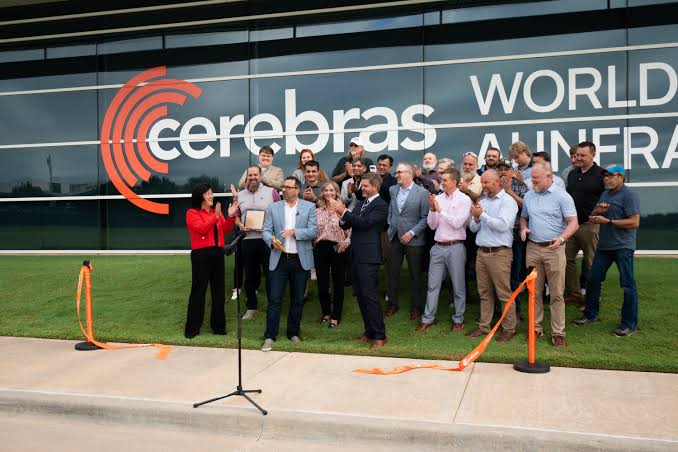
The fastest-growing chip company most investors still can’t correctly value just went public — andthe demand curve behind it looks less like a cycle and more like a permanent step-change in compute consumption. Cerebras Systems built the world’s largest chip, the Wafer-Scale Engine, specifically to solve the bottleneck that Nvidia’s GPU architecture cannot: real-time, ultra-low-latency AI inference at scale. In this issue, G.L.A. runs CBRS through The Gauntlet scoring system, pulls fresh color straight from CEO Andrew Feldman’s own mouth at the Raise AI Summit in Paris, and flags a smaller, earlier-stage peer, d-Matrix, that we believe is positioned to be the next high-value inference acquisition target — following the blueprint Nvidia just wrote with Groq.

Straight From the Founder of Cerebras: Feldman on Why Hardware Is Suddenly Cool
Speaking at the Raise AI Summit in Paris on the Sorcery podcast, Cerebras co-founder and CEO Andrew Feldman laid out the macro backdrop in blunt terms:“the demand for AI has sort of outpaced everybody’s expectation, everybody’s forecast. And so everybody’s chasing chips or they’re chasing memory or they’re chasing data centers”. Feldman described the current moment as “a Cambrian explosion of ideas” in chip architecture, and noted that hardware — unfashionable for a decade — is now “hard to get”. This is exactly the kind of “must-have,” structurally under-supplied product dynamic G.L.A. looks for under Gauntlet Rule 3.

On the OpenAI relationship, Feldman confirmed the scale directly: “we announced in January a huge partnership,one of the biggest deals done in Silicon Valley history. We’ll be doing more than 20 billion dollars of hardware for them over the next several years”. He tied the deal explicitly to the inference thesis, explaining that as AI models become genuinely useful, “everybody wants to use it… and they want to be fast. And that’s sort of where we come in… not by a little bit, but by 20x”.

The Data Center Bottleneck Is Real, Not Cyclical
Feldman also addressed the physical constraint underlying the entire AI capex cycle: “data centers had historically moved at the speed of real estate… two years ago nobody cared about AI… the AI explosion happened so quickly, we’ve outstripped the demand for compute, for memory… and they haven’t made [data centers] fast enough. So people are chasing data centers around the world”. He noted the industry is now retrofitting decades-old backup power infrastructure, with operators turning to fuel cells and jet-engine turbines for power generation, and predicted space-based data centers remain “more than five years away” despite the hype. This supports my view that the inference buildout is supply-constrained for years, not a short-term demand spike — a favorable setup for hardware providers with contracted capacity.
The Thesis: Inference Demand Is Not Cyclical, It’s Structural
The AI industry has shifted from a training-compute arms race to an inference-compute arms race — every chatbot query, every agentic workflow step, every enterprise copilot call now consumes inference cycles continuously, in perpetuity, rather than in one-time training bursts. Cerebras built its Wafer-Scale Engine and CS-3 systems around this exact shift, positioning itself as “the world’s fastest AI inference and training platform,” a claim reinforced by third-party benchmarking that ranks Cerebras and rivals Groq and SambaNova as the primary silicon challengers to Nvidia’s GPU dominance in the inference category. Feldman’s framing of the co-design shift between chips and software — “AI has gotten so large and speed is so important that they’re thinking about the design together… one of the advantages of our relationship with OpenAI is we get to see exactly where the frontier is going and we get a chance to roll that into our designs” — underscores a moat dynamic that’s difficult for generalist GPU vendors to replicate quickly.
Revenue Growth: From Startup to Scaled Public Company in Three Years
Cerebras’ revenue trajectory is the kind of hyper-growth ramp G.L.A. looks for at the earliest visible inflection point of a hardware platform’s adoption curve.
Year | Revenue | YoY Growth |
|---|---|---|
2022 | $24.6M | — |
2023 | $78.7M | ~220% |
2024 | $290M | ~269% |
2025 | $510M | 76%sacra+1 |
Q1 2026 (latest quarter) | $193.4M | 94% YoY, +13% QoQ |
TTM (as of mid-2026) | $603.9M | +192.5% |
Cerebras posted $238 million in net income on $510 million of 2025 revenue — a roughly 47% net margin that is unusually strong for a hardware company still scaling production. Morgan Stanley has modeled the company reaching approximately $8 billion in revenue by 2028, implying the current ramp is still in its early innings relative to management and sell-side expectations.
Customer Concentration: The Double-Edged Sword
Cerebras’ customer list is short but enormous in dollar terms, and this concentration is both the company’s biggest opportunity and its most-cited risk by analysts covering the IPO.
OpenAI — the Master Relationship Agreement Feldman personally called “one of the biggest deals done in Silicon Valley history,” worth more than $20 billion over three years for 750 MW of AI inference capacity, expandable to 2 GW by 2030, with OpenAI receiving warrants that could convert into up to a 10% equity stake in Cerebras as spending escalates.
Mohamed bin Zayed University of Artificial Intelligence (MBZUAI) — accounted for roughly 62% of 2025 revenue.
G42 — the Abu Dhabi AI group, roughly 24% of 2025 revenue and holder of $1.43 billion in long-term purchase commitments.
Combined, just two customers represented approximately 86% of 2025 revenue, a concentration risk flagged prominently in the S-1 filing.
Cerebras also disclosed a $24.6 billion backlog heading into its IPO, and a binding term sheet with AWS to integrate CS-3 hardware into the Amazon Bedrock managed inference service.
The concentration is a legitimate risk factor — losing OpenAI, MBZUAI, or G42 would be existential in the near term — but the sheer size of the multi-year contracted backlog gives G.L.A. confidence in revenue visibility through the next several years even as the customer base diversifies. Coach Kyle’s 00.2 – Open Ai is trying to get as much compute as possible, they will not end this relationship.

IPO and Current Market Snapshot
Cerebras priced its IPO in the $28–$32 range before surging well past that level. As of mid-2026, CBRS trades around $172.85–$172.86, with a market capitalization near $39–$48.6 billion depending on the data source’s share-count timing, trailing-twelve-month revenue of $603.9 million, and a trailing P/E near 156x. Wall Street’s 11-analyst consensus rating is “Strong Buy,” with a 12-month price target of $291.09, implying roughly 68% upside from current levels. On life two months post-IPO, Feldman noted candidly that the biggest change has been an explosion in inbound requests — “the number of people who want something” — requiring a bigger triage operation between his executive assistant and chief of staff, and reflected that reaching IPO is “not the end of a journey… it’s sort of a plateau… the arrival at corporate adulthood” that provides more capital and reach to “prosecute our vision”.

Running CBRS Through The G.L.A. Gauntlet (our Proprietary Scoring System)
Gauntlet Rule | CBRS Assessment | Verdict |
|---|---|---|
1. Min. $2B market cap / $100M revenue | ~$39–48B market cap; TTM revenue ~$604M | Pass |
2. Visionary founder focused on innovation | Andrew Feldman, repeat chip entrepreneur, built the largest chip ever made; explicitly frames the mission around fast inference and co-designed architecture | Pass |
3. “Must-have” product/service | WSE/CS-3 solves latency bottleneck GPUs can’t; OpenAI signed a $20B+ MRA; Feldman notes the industry is “hard to get” hardware right now | Pass |
4. Early-stage hyper-growth + fortress balance sheet / FCF potential | 76-94% YoY growth, 47% net margin in 2025; balance sheet strength still maturing post-IPO | Pass (watch) |
5. Huge TAM | Global AI inference market projected to dwarf training spend as usage scales; data center buildout itself is capacity-constrained per Feldman | Pass |
6. Impenetrable moat | Wafer-scale architecture plus hardware/software co-design with OpenAI is hard to replicate; but GPU incumbency and Groq/SambaNova competition are real | Pass (moderate) |
7. Best risk/reward, risks we’re comfortable with | Customer concentration (86% in two accounts) is the key risk; Feldman’s own warning about Nvidia using balance sheet strength to “limit competition” is a sector-wide risk to monitor | Pass (with risk flag)I See inference demand through 2029 |
8. Solving major societal problems | Enables real-time AI at scale — foundational infrastructure, not a “nice to have”; Feldman ties the mission to breakthroughs in cancer research and personalized education | Pass |
9. Proven investors behind the stock | Tiger Global, AMD, Benchmark, Coatue, Fidelity participated in the $1B Series H; early board backing from veteran chip investor Pierre Lamond | Pass |
10. Wall Street doesn’t fully understand it | High P/E, customer concentration, and “single-purpose chip” narrative keep many generalist investors on the sidelines | Pass |
G.L.A. Gauntlet Score: 9.5/10 — Full Position Candidate. The only real blemish is customer concentration, which we treat as a “risk we’re comfortable with” given the size and multi-year nature of the OpenAI, MBZUAI, and G42 commitments and the emerging AWS relationship that begins to diversify the base.

For New Investors $CBRS under $200 is a great entry IMHO
The Sector Play: Why d-Matrix Could Be the Next Groq or CEREBRAS

Nvidia’s acquisition of Groq’s inference technology assets for roughly $20 billion in December 2025 — its largest deal ever — is the single most important data point for anyone tracking the inference-silicon landscape. It confirmed that low-latency inference specialists command premium strategic value precisely because they solve a problem Nvidia’s own GPU stack handles inefficiently. G.L.A. believes d-Matrix is positioned to follow a similar trajectory.
d-Matrix, backed by Microsoft, raised a $275 million Series C round in November 2025 co-led by the Qatar Investment Authority and Singapore’s EDBI, valuing the company at $2 billion and bringing total capital raised since its 2019 founding to $450 million. The company’s flagship Corsair platform entered full production in June 2026, with volume shipments now going out to hyperscalers, neoclouds, and frontier AI labs. Corsair is architected specifically to handle the “decode” phase of inference — the token-by-token generation step that dominates real-world LLM serving costs — while leaving “prefill” tasks to GPUs, making it a complementary rather than head-on competitive product inside existing Nvidia-based data centers. That positioning, similar to Groq’s before its acquisition, is exactly the kind of niche-but-critical technology profile that made Groq attractive to Nvidia at a $20 billion price tag.(BUYOUT TARGET FOR SURE)

Why d-Matrix Fits the Buyout Pattern
Narrow, defensible technical wedge: in-memory computing architecture built purely for inference economics, not a general-purpose GPU competitor.d-matrix
Strategic backers already in the Nvidia/Microsoft orbit: Microsoft’s existing investment creates a natural bridge for a strategic acquirer narrative.bloomberg
Production-ready product with hyperscaler traction: Corsair’s move to full production in mid-2026 with shipments to hyperscalers de-risks the “vaporware” concern common with chip startups.aiweekly+1
Valuation still modest relative to Groq’s pre-deal position: at a $2 billion valuation, d-Matrix trades at a fraction of what Groq commanded before its $20 billion Nvidia deal, leaving substantial re-rating room if it hits similar production and customer milestones.
Fits Feldman’s own diagnosis of the market: his warning about Nvidia using capital to lock in NeoClouds and model builders cuts both ways — it is a risk to independents, but it also raises the strategic value of acquiring an independent inference specialist before a rival does.

Risks to Monitor
Cerebras carries real customer concentration risk, an elevated ~45-156x revenue/earnings multiple depending on the metric used, and no track record operating at hyperscale infrastructure scale — all flagged explicitly in its own S-1 filing. Feldman’s own commentary on Nvidia’s ability to use its balance sheet to steer NeoClouds and model builders away from competing silicon is a structural headwind worth tracking closely for the entire non-Nvidia inference cohort. d-Matrix, as a private company, carries illiquidity risk, execution risk on scaling Corsair production, and the possibility that any acquirer (Nvidia, AMD, or a hyperscaler) could structure a technology-licensing deal rather than a full buyout, as occurred with Groq rather than an outright acquisition. G.L.A. views both as risks we are comfortable underwriting given the size of the underlying inference TAM and the quality of capital and customers already committed to each company.