The Infinite Innovation Newsletter | PRE-IPO WEEKLY
STRIPE INC. — The New King of Payments & Commerce Infrastructure

“The internet had become programmable. But money had not. Patrick and John Collison decided to change that.”
Happy Tuesday To The Greatest living American’s!
At G.L.A. INVE$T RESEARCH, we do not throw around the word “blue chip” lightly when it comes to private companies. But Stripe Inc. has earned it. We believe Stripe is one of the most important, most defensible, and most strategically positioned private companies on the planet — sitting at the intersection of every major secular trend reshaping the global economy: AI, e-commerce, stablecoins, and global digital infrastructure.
In 2025, businesses on Stripe processed $1.9 trillion in total payment volume — up 34% year-over-year, equivalent to roughly 1.6% of global GDP — across more than 5 million businesses using Stripe directly or through platforms. Its fast checkout product, Link, is now used by more than 200 million people. A February 2026 tender offer valued Stripe at $159 billion, up 74% from just twelve months prior.stripe+2
This is not a startup anymore. This is generational infrastructure — and we believe Stripe belongs in the same conversation as the Magnificent 7 and FAANG as the defining blue-chip growth company of the next decade.
🧠 THE FOUNDERS — Two Brothers Who Changed the Internet’s Financial Plumbing

Patrick and John Collison are not accidental billionaires. They are serial builders from County Tipperary, Ireland, who earned the right to build Stripe through hard experience.
Before Stripe, John and Patrick had already founded Auctomatic (formerly Shupa), a marketplace tool that went through Y Combinator and sold for approximately $5 million — while John was still just 17 years old. That exit gave them deep, firsthand knowledge of how painful and fragmented online payments were for real businesses.
They then enrolled at two of the world’s premier institutions — Patrick at MIT, John at Harvard — but the pull of building was stronger than finishing degrees. They coded through the night in empty study rooms and eventually concluded that the internet’s payment infrastructure was hopelessly broken. The insight was elegant: it was easy to build something on the web, easy to talk to customers — but still weirdly difficult to actually get paid.
Patrick Collison serves as CEO and John Collison as President of Stripe today. Both remain deeply involved in product direction and long-term strategy. Patrick has been recognized among the most influential technology leaders globally, and Stripe’s culture of intellectual rigor and technical excellence reflects both brothers’ obsessive curiosity. They co-founded the Arc Institute in 2021, a non-profit focused on long-term scientific research — a signal that these founders think in decades, not quarters.kitrum+1
The founder profile is a major bullish signal. They have skin in the game, they continue to run the company, and they have demonstrated a rare combination of technical mastery and business vision across multiple ventures.

WHAT STRIPE DOES — The Operating System for Internet Commerce
At its simplest, Stripe is a financial infrastructure company. Its mission is to help businesses accept payments, manage subscriptions, move money between parties, issue cards, handle tax and fraud, and increasingly manage broader pieces of their revenue operations.stripe+2
But that description undersells the scope of what Stripe has become. Stripe is no longer just a payments API — it is positioning itself as the full operating system for internet commerce.
The company’s product suite is organized around four core pillars:
Payments — Accept cards, wallets, bank transfers, and stablecoins globally in 135+ currencies across 50+ countries
Connect — Power marketplace and platform money routing (16,000+ platforms onboarded, 10+ million active accounts)allocations
Revenue / Billing — Subscription management, invoicing, tax automation, and revenue recognition (on track for $1B ARR in 2026)allocations
Money Management — Treasury, Issuing, Capital lending, and financial accounts
Additional flagship products include:
Stripe Link — 200 million+ consumer users; the fastest checkout experience on the internetstripe+1
Stripe Atlas — Helps founders incorporate companies; a flywheel for acquiring the next generation of businesses
Stripe Radar — Advanced AI-driven fraud detection
Stripe Capital — Business lending that grew funding volume by 45% in 2025, supporting 81,000+ businessesallocations
Stripe Terminal — Unifies online and in-person payments into one system

FUTURE MULTI TRILLION DOLLAR COMPANY – IMHO
The genius of Stripe’s design is that each new product makes the platform stickier. A startup begins with payments, adds subscriptions, expands to marketplace payouts, then tax, then lending, then stablecoins. By the time a business has embedded Stripe into its operational DNA, switching is not a technical decision — it is a business continuity risk.

💰 HOW STRIPE MAKES MONEY — Multiple Compounding Revenue Streams
Stripe’s core revenue engine is elegant and battle-tested:
Transaction Fees (Primary Revenue)
Standard U.S. card processing: 2.9% + $0.30 per successful transaction
In-person payments: 2.7% + $0.05
At $1.9 trillion in annual payment volume, even small basis points translate into enormous revenue.
Platform & Software Fees (Expanding Revenue)
Stripe Billing: Additional fees tied to subscription volume
Stripe Connect: Revenue from orchestration and routing between marketplace parties
Stripe Tax: Monetizing the compliance and accounting layer
Stripe Issuing & Treasury: Fees from embedded banking products
Stripe Radar: Per-transaction fraud screening fees ($0.05–$0.07 per transaction)
Stripe Atlas: $500 setup + $100 annual maintenance per incorporated entity
The Financial Picture
Sacra Research estimates Stripe generated approximately $6.9 billion in net revenue in 2025, up 36% year-over-year from $5.1 billion in 2024, with $1.2 billion in EBITDA. The company’s gross revenue (before paying network fees) reached an estimated $19.4 billion in 2025. Stripe generated approximately $2.2 billion in free cash flow in 2024 and remained “robustly profitable” into 2025, per its own annual letter.stripe+4

The Revenue Suite alone — including Billing, Invoicing, and Tax products — is on track to hit a $1 billion annual run rate in 2026. This is a company that has cracked the code on massive scale, strong growth, and profitability simultaneously — a combination that is genuinely rare at this stage.

NOTABLE BACKERS & INVESTORS — The Ultimate All-Star Bench
Stripe’s investor roster reads like a who’s who of Silicon Valley’s finest — and includes some of the most prescient technology investors in the world: LITERALLY THE BEST INVESTORS IN THE WORLD OWN STRIPE!!
Investor | Background |
|---|---|
Sequoia Capital | First investor in Apple, Google, Airbnb, Stripe |
Andreessen Horowitz (a16z) | Led or participated in multiple Stripe rounds |
Peter Thiel | PayPal co-founder; Stripe seed investor |
Elon Musk | PayPal co-founder; early Stripe backer |
Max Levchin | PayPal co-founder; early investor |
General Catalyst | Major institutional backer; participated in growth rounds |
Baillie Gifford | Scottish fund manager famous for long-term mega-winners (Amazon, Tesla) |
Y Combinator | Earliest institutional supporter; Stripe is among YC’s greatest outcomes |
Sam Altman | OpenAI CEO; early angel investor in Stripe |
Capital G (Alphabet’s VC) | Growth-stage participant |
That PayPal mafia backing is particularly meaningful: the people who suffered through the pain of first-generation online payments invested in Stripe because they recognized the magnitude of the problem being solved. Stripe has raised a total of approximately $9.81 billion across 15 funding rounds.

THE PROBLEM STRIPE SOLVES — Why This Matters
Before Stripe, accepting payments online required setting up a merchant account, negotiating with gateways, wrestling with compliance, building fraud systems from scratch, and writing thousands of lines of ugly, fragile code. The internet was programmable. Money was not.
Stripe solved this by making payments feel like software, not paperwork. The original promise — “add a few lines of code and you’re live” — democratized commerce for an entire generation of internet businesses.
The business problems Stripe eliminates for its customers:
Fragmentation — Replace 5–10 vendors with one platform
Development time — Reduce months of integration to days
Global complexity — Accept 135+ currencies in 50+ countries without local banking relationships
Compliance risk — Automated tax, identity, and fraud handling
Cash flow management — Instant payouts, Stripe Capital loans, Treasury accounts
Agentic readiness — The only infrastructure ready for AI agents making autonomous purchasesstripe+1
Every dollar a business spends solving these problems without Stripe is a dollar Stripe can capture as revenue. At global scale, that is a vast market opportunity.

📐 TOTAL ADDRESSABLE MARKET (TAM) — The Opportunity is Staggering
Stripe’s TAM is one of the most compelling in all of technology:
Global Payments Market: Estimated at $788 billion in 2025, growing to $1.24 trillion by 2030 at a 9.8% CAGR.
Global E-Commerce: Expanding across 50+ countries Stripe serves, with 57% of new Stripe businesses now based outside the U.S.
Stablecoin Market: Stablecoin payment volume doubled industrywide to ~$400 billion in 2025; adjusted stablecoin transaction volume reached $5.8 trillion in 2024stripe+1
AI/Agentic Commerce: Entirely new market vertical where AI agents autonomously purchase goods and services — Stripe is the early infrastructure standardstripe+1
Embedded Finance / Banking-as-a-Service: Cards, lending, and treasury products layered on top of payments infrastructure
Stripe currently commands approximately 20.8%–29% of the global online payment processing market, second only to PayPal, and approximately 45% of the U.S. domestic online payments market. The total opportunity expands every year as more of global commerce migrates online — and as AI agents begin transacting autonomously.

THE MOAT — Why Stripe Is Nearly Impossible to Dislodge
G.L.A. INVE$T RESEARCH views Stripe’s competitive moat as one of the deepest in private tech. It is multi-layered and self-reinforcing:
1. Developer Ecosystem Lock-In
Stripe is the default choice for developers globally. More than 60% of venture-backed startups in North America and Europe run on Stripe. A generation of developers has learned to build commerce on Stripe — changing that institutional knowledge base is not a pricing decision; it is a generational shift.
2. Network Effects
Stripe Link has 200 million+ consumer users. Every new consumer enrolled in Link increases checkout conversion for every merchant on the platform. More merchants attract more consumers. The flywheel is self-perpetuating.
3. Platform Breadth Creates Switching Costs
A company using Stripe for payments, billing, tax, Connect, Capital, and Treasury faces enormous operational risk in switching providers. The more products a customer adopts, the higher the switching cost — and the higher the revenue per customer for Stripe.
4. Data Moat
Stripe processes payments for 90% of the Dow Jones Industrial Average and 80% of the NASDAQ 100. The volume and diversity of transaction data Stripe has access to creates fraud models, risk scoring, and lending algorithms that no new entrant can replicate quickly.
5. Infrastructure Standard for the AI Economy
By co-developing the Agentic Commerce Protocol (ACP) with OpenAI, Stripe has planted its flag as the payments infrastructure standard for autonomous AI commerce. When AI agents buy things on the internet, they will be buying through Stripe.
6. Stablecoin First-Mover Advantage
The $1.1 billion acquisition of Bridge closed in February 2025, making Stripe the owner of the leading stablecoin orchestration platform. Bridge saw volumes quadruple in 2025. The acquisition of Privy adds crypto wallet infrastructure. Stripe is building a vertically integrated stablecoin stack from settlement to user interface.

🚀 GROWTH TRAJECTORY — Accelerating Into the Future
Stripe’s growth story is not a “what happened” story — it is a “what is happening right now” story:
Metric | Figure | YoY Change |
|---|---|---|
Total Payment Volume (2025) | $1.9 Trillion | +34% |
Estimated Net Revenue (2025) | ~$6.9 Billion | +36% |
Free Cash Flow (2024) | ~$2.2 Billion | — |
Valuation (Feb 2026 Tender) | $159 Billion | +74% from Feb 2025 |
Stripe Link Users | 200 Million+ | — |
Connect Platforms & Marketplaces | 16,000+ | — |
Stripe Capital Funding Volume Growth | +45% in 2025 | — |
Businesses Supported by Stripe Capital | 81,000+ | — |
New 2025 Business Cohort Growth Rate | ~50% faster than 2024 cohort | — |
Three strategic growth vectors are particularly exciting heading into 2026 and beyond:
🤖 Artificial Intelligence
Stripe powers all of the top AI companies globally. OpenAI, Anthropic, and essentially every AI lab uses Stripe for billing and payments. The co-developed Agentic Commerce Protocol with OpenAI puts Stripe at the center of the next frontier of commerce — transactions initiated by AI agents on behalf of humans.
🌍Global by Default
More than 57% of new Stripe businesses in 2025 were based outside the U.S. Stripe’s global-first strategy puts it on a trajectory to capture the lion’s share of emerging market digital commerce growth over the next decade.
🪙Stablecoins & Programmable Money
Stablecoin payment volume on Stripe doubled to ~$400 billion industrywide in 2025. With Bridge and Privy integrated, Stripe’s own stablecoin chain Tempo is live, and USDC settlement and cross-border payouts on-chain are now operational. Stripe is not just adapting to this future — it is building the rails.

🏆 NOTABLE CUSTOMERS & CONTRACTS — The Who’s Who of the Internet Economy
Stripe’s customer list is a testament to its blue-chip status:
Enterprise & Fortune 500:
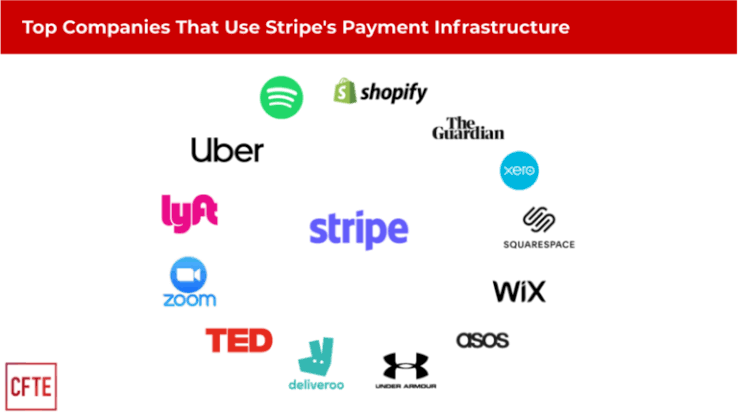
Amazon | Ford | Hertz | Siemens | Samsung | Accenture | Zara
Tech Giants & Platforms:
Shopify | OpenAI | Anthropic | Etsy | DoorDash

AI Infrastructure:
Powers all top AI companies globally — every major AI lab bills through Stripe
Index Penetration:
90% of the Dow Jones Industrial Average
80% of the NASDAQ 100
Platform Scale:
More than 16,000 platforms and marketplaces use Stripe Connect
More than 100 companies each process over $1 billion annually through Stripe
Over half of every recent Y Combinator batch runs on Stripe
The Shopify + OpenAI + Stripe partnership represents the first working model of agentic commerce at scale — a landmark moment in the evolution of internet transactions.

📈 PATH TO EXIT FOR INVESTORS — How This Story Resolves
This is the question every sophisticated investor asks, and here is the honest, bullish answer:
The Tender Offer Path (Current)
Stripe has conducted annual tender offers since 2024. The February 2025 tender valued Stripe at $91.5 billion; the February 2026 tender pushed that to $159 billion (+74% in 12 months). For pre-IPO investors accessing shares through secondary markets (Hiive, Forge Global, EquityZen), these tender offers represent annual liquidity windows and built-in price discovery.
The IPO Path (Most Likely 2027 Window)
Stripe has not filed a confidential S-1 as of mid-2026. The Collison brothers have stated publicly they are “not dogmatic on the public vs. private question.” Analyst consensus points to a late 2026 to 2027 IPO window as the most likely path. With $2.2 billion in free cash flow, robust profitability, and annual tender offers providing employee liquidity, Stripe can afford to wait for ideal market conditions — and will likely IPO at a premium to its current private valuation.
The Direct Listing Option
Stripe has reportedly explored a direct listing as an alternative to a traditional IPO. Given its brand recognition and the maturity of its investor base, a direct listing could unlock public market access without the dilutive dynamics of a traditional offering.
Why the Wait Is Bullish, Not Bearish
Every month Stripe stays private is another month of compounding the business at 34%+ growth rates. The company is not staying private because it has to — it is staying private because it can. That optionality is a privilege reserved for only the world’s greatest businesses.

🔮 GLA RESEARCH VERDICT — Our Investment Thesis
At G.L.A. INVE$T RESEARCH, we rate STRIPE INC. as a STRONG BUY in the pre-IPO market.
Here is our investment thesis in plain terms:
Stripe is building the financial nervous system of the internet. Every new business that launches online, every AI agent that transacts autonomously, every stablecoin that moves cross-border — Stripe wants to be underneath all of it, quietly collecting a small fee every time the internet gets paid.
We believe Stripe is in the exact same mold as the Magnificent 7 and FAANG companies in their pre-public or early-public phases. Think about what Amazon was in 2002. What Google was before its 2004 IPO. What Facebook was before 2012. Each of these companies was already dominant infrastructure with network effects, expanding TAMs, and the ability to compound growth at rates that seemed unsustainable — until they sustained them for another decade.
Stripe is that company for the financial layer of the internet.

The Bull Case:
$1.9T in payment volume growing at 34% YoY = compounding toward a $10T+ processing platform within a decade.
Infrastructure standard for AI agentic commerce — a market that does not yet exist at scale but will.
Stablecoin rails through Bridge position Stripe for the tokenized economy.
90% DJIA penetration and 80% NASDAQ 100 penetration means Stripe is already a systemically important financial infrastructure company.
Profitability AND 34%+ growth rate simultaneously — almost no company at this scale achieves.
Founders are still at the helm, still building, still thinking 10 years.
Risk Factors (Balanced View):
-Regulatory risk as Stripe’s infrastructure becomes increasingly systemically important
Competition from Adyen, PayPal, and emerging fintech challengers
Margin compression possible if card networks renegotiate pricing
Our Conclusion: For private Market Investors—The upside is generational. Stripe at a $159 billion private valuation today could be a $500 billion to $1 trillion company within 5–7 years of its IPO — comparable to the trajectory of every Magnificent 7 company at a similar stage of development.
BLUE CHIP INNOVATION!!


NOT INVESTMENT ADVICE – EDUCATIONAL PURPOSES
G.L.A. INVE$T RESEARCH — The Infinite Innovation Newsletter is produced for informational and educational purposes for accredited investors and qualified purchasers. This newsletter does not constitute investment advice or a solicitation to buy or sell securities. Pre-IPO investments involve significant risks including illiquidity, no guaranteed exit, and potential total loss of invested capital. Past performance of private companies is not indicative of future results. Always consult with a licensed financial advisor before making investment decisions.