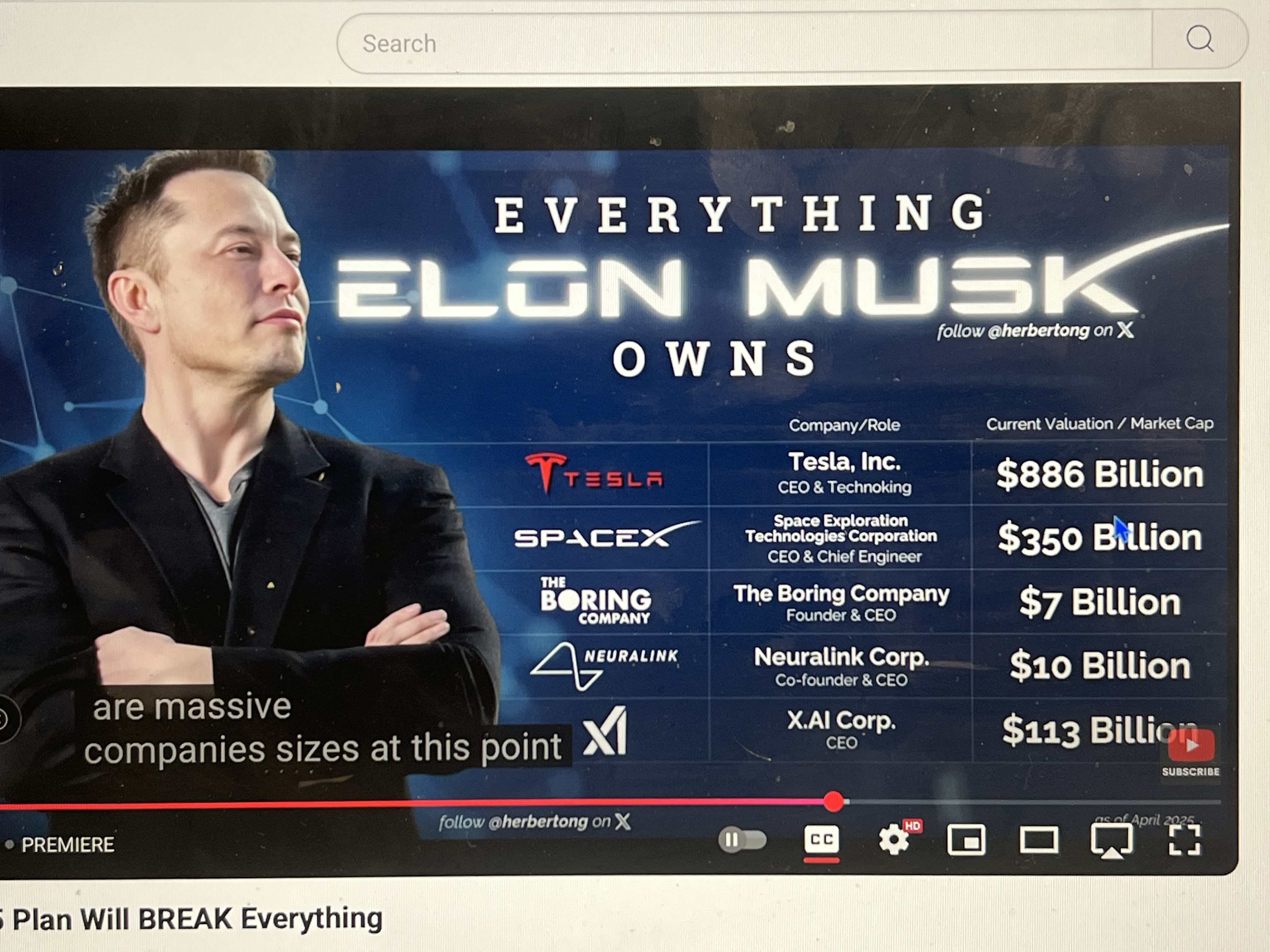

Happy Wednesday Folks! Back at it this morning with more Elon Musk Predictions, as you know at G.L.A INVEST RESEARCH we believe Elon Musk is the most important human on the planet, his mission is to create “Sustainable Abundance” for all humans..
Musk argues that digital AI will soon match or exceed humans at all software, engineering, and other non-physical work, lifting global GDP by 20–30% (~$20–30 trillion of extra annual output).Physical robotics will take longer because of supply chains and “moving atoms,” but the combination of rapidly improving robot AI software, onboard chips, and hand dexterity will produce a general-purpose humanoid whose usefulness multiplies those three factors. Once robots can manufacture more robots, growth becomes recursive and explosive. He projects well over a billion humanoid robots in 10 years, each roughly 5× as productive as a human—collectively more productive than all humans combined. He also highlights an imminent electricity crunch (consensus ~15 GW shortfall for AI chips in 2027) that already forces companies to lease SpaceX compute because SpaceX built its own power. Countries that add generation and data-center capacity can capture tax and fee revenue. The video host treats the robot-scale forecast as Musk’s highest-confidence prediction to date and urges viewers to ask “what if he’s even close to right?” for Tesla and SpaceX.Most important points for investors
Watch the media linked in this archived editionDigital AI timeline and scale: Musk expects AI to handle “anything digital” (anything that does not require physically shaping atoms) by the end of next year and to reach “Stockfish-level” (unbeatable by humans) performance in software writing, plus very high competence in all engineering, within 12–18 months. He estimates this alone adds 20–30% to global GDP, or on the order of $20–30 trillion per year.
Robotics as the much larger second wave: General-purpose humanoid robots are described as capable of increasing the economy by a factor of 10 or more. Usefulness is framed as (AI software quality) × (onboard AI chip quality) × (electromechanical dexterity, especially hands); all three are improving exponentially.
Recursive manufacturing and 10-year numbers: Robots will manufacture more robots, producing slow-then-explosive growth. Musk’s explicit 10-year forecast (one he said he would bet serious money on) is well over 1 billion humanoid robots, each ~5× as productive as a human, so the fleet would out-produce all humans combined. He called this a conservative estimate.
Physical vs. digital speed: Anything that requires atoms and global supply chains takes longer than pure software. That is why robot scale-up lags digital AI even though the underlying intelligence is advancing fast.
Power bottleneck is already here and worsens in 2027: AI-chip production is rising ~40–50% per year while electricity available outside China is rising only ~10–20%. Consensus among close AI watchers is at least a 15 GW shortfall next year. SpaceX is already leasing compute to Google, Anthropic and others because it built its own plants; the video notes SpaceX is also moving to produce turbine blades/vanes itself because commercial lead times now stretch to 2030.
Direct company implications highlighted in the video: Tesla’s Full Self-Driving is already called a “tremendous boon”; Optimus is positioned as the vehicle for the humanoid-robot forecast. SpaceX (and related xAI compute/energy efforts) is already monetizing scarce power and is building more generation capacity. IMHO even if Musk’s dates slip by a large margin, the directional implications for these businesses remain large.
Policy/opportunity angle: Countries that rapidly add electricity and data-center infrastructure can attract AI training/inference loads and collect taxes/fees. Export controls keep the latest chips out of China, so the relevant power-growth comparison is “outside China.”
Mindset Musk recommends: Adopt a “lean-forward, try new technologies” stance rather than remaining stuck in the past; new technologies need encouragement.
These are Musk’s stated predictions and the video’s framing of them, not independently verified forecasts. Timelines have historically been optimistic; the economic-magnitude claims are extremely large even if delayed. Investors should treat the numbers as scenario inputs (especially for Tesla robotics optionality and energy/compute scarcity) rather than base-case certainties.