From: G.L.A.INVE$T RESEARCH
Date: March 27, 2026

Happy Friday to the Greatest Living Americans!!
I’ve been sitting with this one for a while. After spending the last few weeks going deep into ARK Invest’s Big Ideas 2026 report, cross-referencing it with our own G.L.A. INVEST BIBLE, and watching what’s happening in real time across AI, robotics, energy, and blockchain — I need to lay out exactly what we believe is coming over the next 1 to 3 years and what it means for your money.
This isn’t hype. This isn’t clickbait. This is 25 years of finance experience telling you: we are entering the most transformative period for wealth creation in modern history. And if you’re not positioned correctly, you will be left behind.
Let’s get into it.

Corrections Come and They Pass.
WE ARE IN THE EARLY INNINGS OF THE BIGGEST DISRUPTION CYCLE EVER
ARK Invest’s Big Ideas 2026 report calls it “The Great Acceleration” — and we agree completely. Five major innovation platforms are converging simultaneously: Artificial Intelligence, Robotics, Energy Storage, Public Blockchains, and Multiomics. This isn’t five separate stories. They are feeding into each other, compounding, and accelerating at a pace that traditional Wall Street models simply cannot capture.
Here are the numbers that should wake you up:
ARK projects real GDP growth could average more than 7% annually by the end of this decade — more than double the 3% average we’ve seen for the past 125 years. That’s not a typo. Seven percent real growth, driven by technological convergence and productivity gains the world has never seen before.
Innovation-driven companies could represent over 60% of global equity market capitalization by 2030. Right now, that number is a fraction of that. The last time a technology wave this dominant reshaped markets was the railroad era of the 1870s, when 75% of U.S. stock market cap was concentrated in a single innovation platform.
AI inference costs are dropping up to 99% per year. Training costs are declining 75% per year. Software development costs have dropped 91% in just 8 months. This isn’t slowing down — it’s accelerating.
Data center systems spending hit nearly $500 billion in 2025 and is projected to reach $1.4 trillion by 2030. Hyperscalers alone could spend over $500 billion in 2026.
Humanoid robots could add $6 trillion — roughly 20% — to U.S. GDP as they enter households and the workforce. ARK estimates a single household robot contributes approximately $62,000 per year to GDP.
Productivity growth is projected to sustain at 4–6% annually, a level that historically only appears at cyclical peaks before falling back. This time, it’s structural.
Cathie Wood herself said the U.S. economy is a “coiled spring” — and we believe she’s right. Nominal GDP growth could hover in the 6–8% range over the next few years, driven by 5–7% productivity growth, deregulation, lower interest rates, and AI-driven efficiency gains that are just beginning to flow through every sector.

EXPECT MASSIVE VOLATILITY — EMBRACE IT, DON’T FEAR IT
Here’s what we need to be honest about: this disruption will not be smooth. Anyone who tells you this transition happens in a straight line up is lying to you.
The next 1 to 3 years will bring massive volatility. That’s not a prediction — that’s a certainty. When you have this level of disruption colliding with an economy in transition, with legacy industries being displaced, with AI eliminating jobs at a pace we’ve never seen — Meta just cut 16,000 employees tied directly to AI automation, Block cut 50% of its workforce — you get turbulence.
Markets are going to swing violently. Innovation stocks will have drawdowns that shake out weak hands. There will be days, weeks, and even quarters where your portfolio looks ugly on paper. The media will scream “crash.” The talking heads will say “I told you so.” And the advisors who never did the research will panic their clients into selling at exactly the wrong time.

This is where the G.L.A. INVEST BIBLE becomes your anchor.Original edition – CLICK TO VIEW The G.L.A INVE$T BIBLE aka Our Investing Constitution
Rule #1: Time in, not timing. Rule #6: Volatility is vitality. Rule #8: Drawdowns are opportunities, not emergencies. Rule #17: The masses sell at the bottom and buy at the top — we do the opposite.
We’ve been through this before. The “SEXY 6” portfolio was down 67% in 2022. By the end of 2024, it was up 212% for that year alone. The CAGR since 2021 sits at 72% That kind of compounding doesn’t happen without pain. Volatility is the price of admission to exponential growth, and we pay it gladly.

AI AND ROBOTICS WILL DRIVE MASSIVE INNOVATION AND PRODUCTIVITY
Let’s zoom in on what’s actually happening right now — not in some theoretical future, but today.
AI is the master catalyst. It is accelerating every single one of the five innovation platforms. Consumers are adopting AI at twice the pace of internet adoption in the 1990s. OpenAI hit a $20 billion annualized run rate by year-end 2025 — up 12.5x in one year. Anthropic went from $100 million to $9 billion in the same timeframe — a 90x increase. These are among the fastest-growing businesses in human history.
Robotics is at a commercial inflection point. ARK’s data shows robotics has seen the most growth of any innovation platform in convergence network density — up 35% year over year. The economics are improving fast: average revenue per industrial robot unit fell from $31,100 in 2018 to $25,600 in 2024, and the trend is accelerating. Global investment in U.S. manufacturing capacity alone has exceeded $1.2 trillion in announced commitments since January 2025.
The convergence of AI + robotics + energy storage is creating entirely new categories. Autonomous vehicles. Reusable rockets (SpaceX is 10 years ahead of every competitor). Humanoid robots that Cathie Wood herself said are developing faster than expected because of the expertise that evolved around full self-driving technology.
And here’s the part nobody talks about: this is deflationary. AI and robotics are going to bring costs down across the board. ARK believes CPI could drop to surprisingly low or even negative levels in the coming years. That means the real purchasing power of your wealth increases — if you own the companies driving the deflation.

MOST INVESTMENT ADVISORS ARE NOT INCENTIVIZED TO DO THIS RESEARCH
Let me be direct about something that needs to be said.
The vast majority of investment advisors, financial planners, and traditional money managers are not equipped — and frankly not incentivized — to navigate this market. Their business model is built on assets under management, not research quality. They get paid the same whether they put you in an S&P 500 index fund or spend 40 hours a week studying the convergence of AI, robotics, and blockchain technology.
Most advisors are still running the same playbook from 2005: 60/40 portfolio, over-diversify into 40–50 stocks across a dozen sectors, rebalance quarterly, collect their fee, and move on. That strategy was designed for a world that no longer exists. It was built for 3% GDP growth and incremental innovation — not for a world where five technological platforms are converging to produce 7%+ real GDP growth and 60% of global market cap will be concentrated in innovation.
These archaic portfolio strategies will leave you behind. Full stop.
When ARK’s Brett Winton warns that “core investment portfolios lacking exposure to innovation could potentially shrink in real terms over the decade as innovative companies grow enormously in value” — that’s not a sales pitch. That’s math. If innovation companies are compounding at 20%+ annually and your portfolio is sitting in legacy industrials and consumer staples doing 5–7%, you’re not just underperforming — you’re getting poorer in relative terms every single year.
I built G.L.A. INVEST RESEARCH specifically to solve this problem. We are a research firm. We don’t manage your money. We don’t collect AUM fees. We have zero incentive to put you in mediocre investments. Our only incentive is to do the deepest research possible and give you the conviction to hold through the volatility that separates generational wealth from average returns.

A PORTFOLIO OF 10 DIVERSIFIED COMPANIES IS MORE THAN ENOUGH ( NOT INVESTMENT ADVICE )
The G.L.A. INVEST BIBLE is very clear on this: we are against over-diversifying. Rule #10 says it plainly.
Here’s the truth that Wall Street doesn’t want you to hear: diversification beyond a certain point is not risk management — it’s ignorance management. When an advisor puts you in 50 stocks, they’re not protecting you. They’re admitting they don’t know which ones are the best. They’re hedging their own lack of research.
We believe a portfolio of 10 high-conviction, deeply researched, diversified companies is more than enough. Not 10 tech stocks. Not 10 random picks. Ten companies across different innovation platforms, different business models, different stages of growth — but every single one of them vetted against the G.L.A. INVEST BIBLE’s criteria: visionary founders, $2B+ market cap, must-have products, hyper-growth phases, fortress balance sheets, massive TAMs, and superior risk/reward.
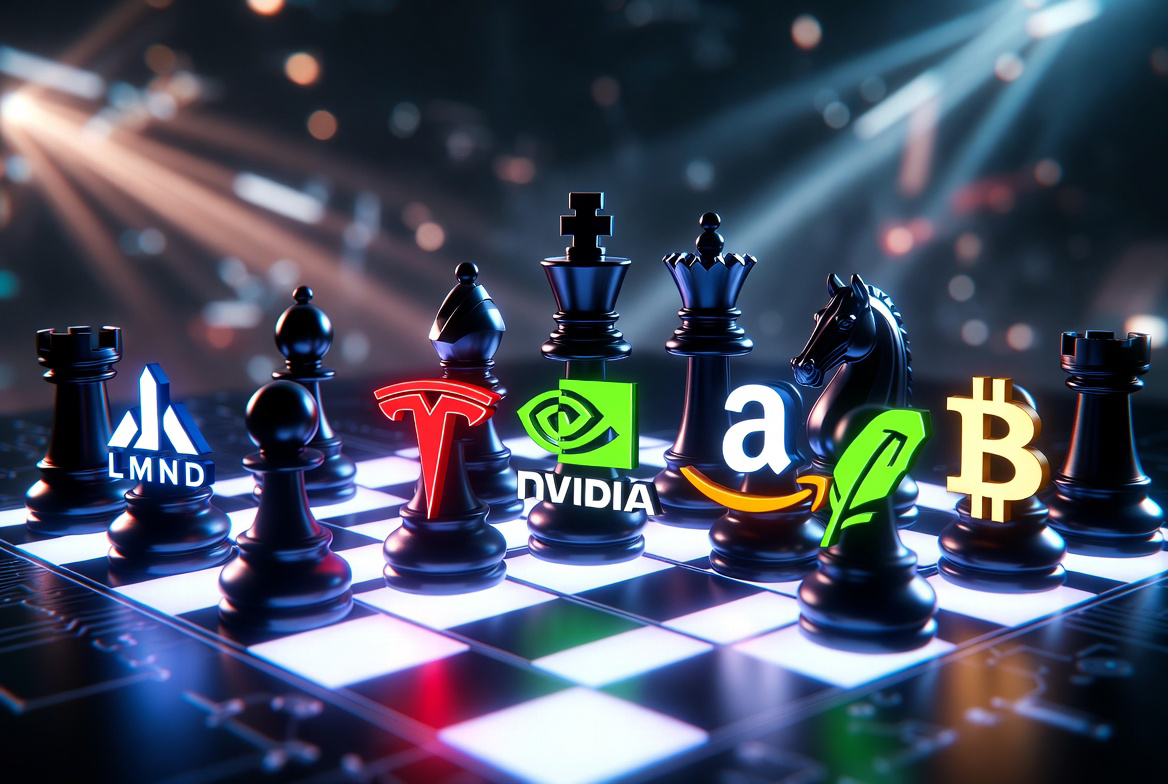
Our APEX 10 Portfolio represents exactly this philosophy:
# | Company | Ticker | Role in Portfolio |
|---|---|---|---|
1 | Tesla | TSLA | AI + Robotics + Energy + Autonomy |
2 | Palantir | PLTR | AI Infrastructure + Data |
3 | Strategy | MSTR | Bitcoin Treasury + Digital Assets |
4 | Robinhood | HOOD | Next-Gen Financial Platform |
5 | NVIDIA | NVDA | AI Compute + Semiconductor Leadership |
6 | ARK Bitcoin ETF | ARKB | Bitcoin Exposure |
7 | Bitmine Immersion | BMNR | Bitcoin Mining + Ethereum |
8 | Amazon | AMZN | AI Cloud + Commerce + Logistics |
9 | Lemonade | LMND | AI-Native Insurance Disruption |
10 | Strategy Preferred (Stretch) | STRC | Income + Capital Preservation Objective |
Every name has a purpose. Every name has been researched obsessively. Every name aligns with the thesis that innovation platforms are converging and compounding.

STRC: THE INCOME PRODUCER AND THE PLACE TO STORE CAPITAL
Let’s talk about STRC — Strategy’s perpetual preferred stock, known as “Stretch.”
In a portfolio built for exponential growth, you still need a place to park capital, generate income, and manage risk. That’s STRC.
Here’s what makes it unique:
Current annualized dividend: 11.50% as of March 2026 — paid monthly in cash. That’s not a typo. Monthly cash distributions at 11.50%.
Perpetual preferred stock — Strategy is not obligated to buy it back at any specified date. It’s designed to trade around its $100 par value.
Variable yield adjusted monthly — the dividend rate adjusts each month to encourage trading near par and reduce price volatility. This is elegant financial engineering from Michael Saylor’s team.
$2.25 billion in reserves backing dividend obligations on Strategy’s preferred stocks, covering approximately $887 million in annual commitments.
Listed on Nasdaq and available on most major brokerage platforms. Highly liquid.
Think of STRC as the anchor of the portfolio. While TSLA, PLTR, and NVDA are compounding at exponential rates, STRC is sitting there quietly paying you 11.50% annually in cash, month after month. It’s the income engine. It’s where you store dry powder. It’s the position that lets you sleep at night while the growth names do their work.
In a world where savings accounts pay 4% and the 10-year Treasury is bouncing around, STRC at 11.50% with monthly distributions is a superior place to store capital — and you get exposure to Strategy’s massive Bitcoin treasury as a bonus.
TRADING THIS MARKET IS BEYOND DUMB

I’m going to say this as directly as I can: attempting to trade this market is beyond dumb.
I spent 20 years as a Series 7 broker watching traders blow themselves up. I watched high-net-worth clients lose millions trying to time entries and exits. I watched brilliant people outsmart themselves into poverty because they couldn’t sit still.
And I’m telling you — trading this specific market, at this specific moment in history, is the absolute worst thing you can do.
Why? Because we are in the early innings of a multi-year innovation supercycle. The companies driving this cycle are volatile by nature. They will have 30% drawdowns. They will have 50% drawdowns. And then, in our thesis, they could rip to new all-time highs; recovery is not guaranteed. If you sell on the drawdown to “protect yourself,” you risk missing a recovery if it occurs.
The G.L.A. INVEST BIBLE exists because of this exact dynamic. Rule #1 is “Time in, not timing” for a reason. The data is overwhelming: missing just the 10 best days in the market over a 20-year period cuts your returns in half. And those best days almost always come right after the worst days — the exact days a trader would be sitting in cash.
Dollar-cost averaging into high-conviction positions. Holding through volatility. Adding on weakness. That’s the strategy. It’s boring. It’s unglamorous. And it works.
Trading doesn’t.

THE BOTTOM LINE: POSITION YOURSELF NOW OR GET LEFT BEHIND
Here’s our belief at G.L.A. INVEST RESEARCH, summarized plainly:
We are in the early innings of the greatest innovation cycle in history. Five technological platforms are converging to produce growth the world hasn’t seen in over a century.
Massive volatility is coming as this disruption takes hold. Industries will be displaced. Jobs will be eliminated. Markets will swing wildly. This is the cost of exponential progress.
AI, robotics, energy storage, blockchain, and multiomics will drive unprecedented productivity and wealth creation. The numbers — 7%+ real GDP growth, 60% of global market cap in innovation, $6 trillion from humanoid robots alone — are not science fiction. They are modeled, researched, and directionally inevitable.
Most investment advisors are not incentivized to do the deep research required.Their archaic portfolio strategies — over-diversified, under-researched, built for a world that no longer exists — will leave you behind.
A portfolio of 10 deeply researched, high-conviction companies is more than enough. Over-diversifying dilutes your best ideas. Concentration with conviction is how generational wealth is built.
STRC is the income producer and the place to store capital. 11.50% annualized, paid monthly, backed by $2.25 billion in reserves. The anchor of any innovation portfolio.
Trading this market is beyond dumb. Time in, not timing. DCA. Hold. Add on weakness. Let compounding do what compounding does.
The next 1 to 3 years will separate those who understood what was happening from those who didn’t. We intend to be on the right side of that divide — and we intend to bring everyone who reads this with us.
