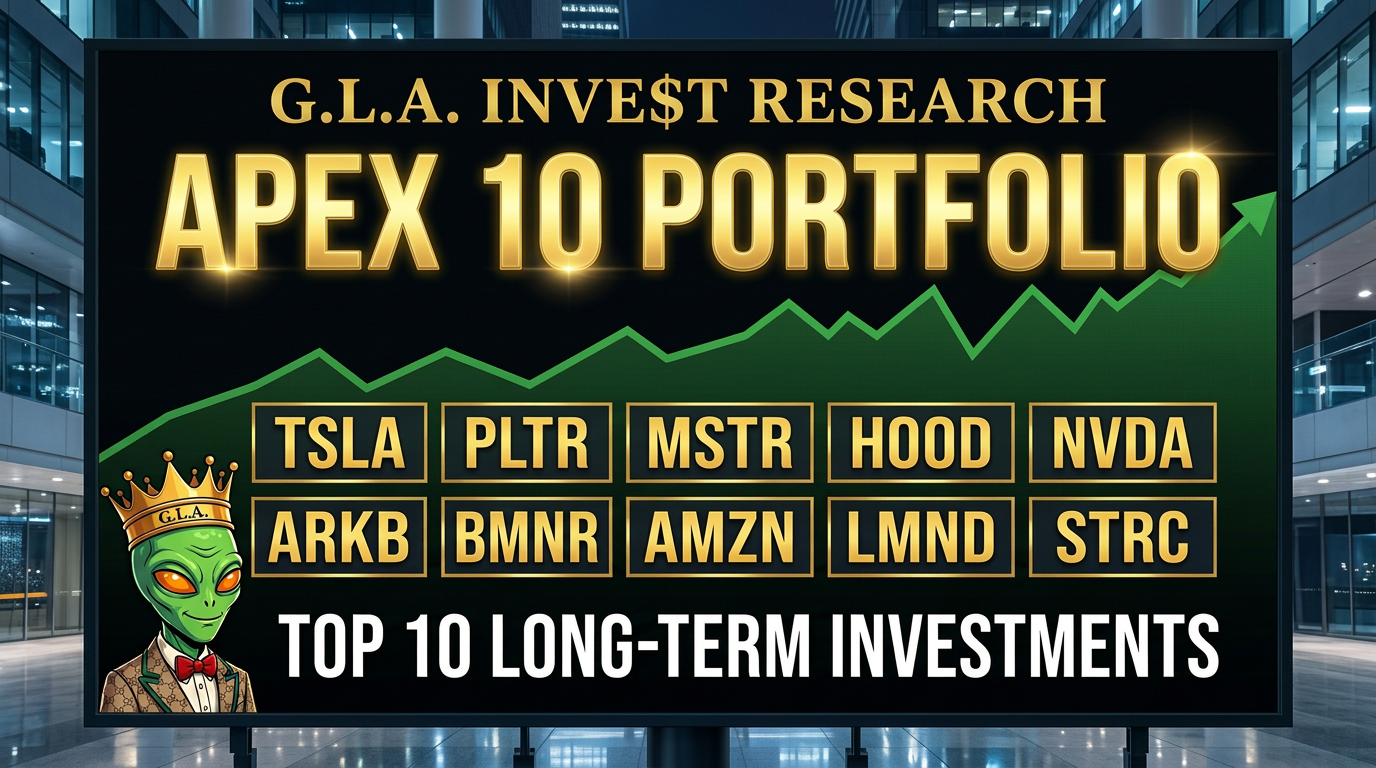
The G.L.A. Proprietary Scoring Framework: A Deep Dive
We rigorously evaluate every potential investment against ten strict criteria. A company must score perfectly to enter our portfolios. We do not chase the hottest story of the week; we rely on this framework to identify the best risk-versus-reward investments for the next 5 to 10 years. “Invest In The Best, Ignore The Rest, Welcome To G.L.A INVE$T! “- G.L.A
1. Size and Predictability
The Rule: Companies must have over a $3 billion market capitalization and more than $100 million in revenue.
The Depth: While there can occasionally be exceptions for hyper-conviction, early-stage plays, scale is vital. The smaller a company is, the more easily it can be destroyed by unexpected macroeconomic events.
Example: During the aggressive 2022 Federal Reserve rate hike cycle, capital became extremely expensive. Many promising but undersized companies went bankrupt simply because they lacked the financial buffer to survive the changing economic winds. ( $NVTA Invitae was one that hurt me personally in 2022)

2. Visionary Leadership & Culture
The Rule: Investments require visionary founders focused on innovation who can build incredible work environments and recruit top-tier, mission-driven talent.
The Depth: True visionaries do not cater to the short-term demands of Wall Street. They will not placate impatient investors by issuing dividends or initiating stock buybacks. Instead, they ruthlessly reinvest every dollar of profit back into innovation to fuel exponential growth.
Example: Leaders like Elon Musk (Tesla), Alex Karp (Palantir), and Michael Saylor (MicroStrategy) bypass short-term appeasement to build fiercely loyal, mission-driven engineering teams that out-innovate the competition. Leaders like Steve Jobs and Elon stay 100 steps in front of their competitors.

3. “Must-Have” Products and Services
The Rule: A company must create indispensable, paradigm-shifting products, rather than discretionary or easily replaceable commodities.
The Depth: If a product is merely a “nice-to-have,” consumers will abandon it during a recession. We only invest in underlying technologies that society fundamentally cannot function without once adopted.
Example: Apple’s iPhone revolutionized global communication, Amazon’s delivery network became the backbone of modern commerce, and Tesla’s Full Self-Driving and Optimus robots are set to become essential solutions for global transport and labor shortages.
4. Hyper Growth Meets Fortress Balance Sheets
The Rule: Target companies must be in the early stages of hyper sales and revenue growth while maintaining a “fortress” balance sheet.
The Depth: Rapid growth must not be built on a fragile foundation of toxic debt. We look for companies entering the steepest part of their adoption curve, backed by massive cash reserves that allow them to aggressively scale without relying on expensive outside capital. We look for companies growing revenue/sales over 40%, with the potential to grow higher in the coming years from a new product or service (ie. Tesla’s Cybercab and Humanoid Robot)
Example: Nvidia (NVDA) and Palantir (PLTR) recently demonstrated this by scaling 10 to 15 times in value over a short period, driven by explosive AI revenue backed by bulletproof financials. We believe $TSLA is next to 10X in value as Cybercab hits production and consumers realize that they can use their Tesla as a cash producing asset.
5. Massive Total Addressable Markets (TAM)
The Rule: The business must operate within a massive TAM with an enormous pool of potential customers.
The Depth: You cannot achieve 20x to 30x returns in a with a trade or with a niche product. We focus exclusively on the sectors poised to add trillions to the global GDP over the next decade, with products or services that change the way we live.
Example: We position our capital in mega-trends like Artificial Intelligence, robotics, energy storage, blockchain, and genomics, where the potential customer base spans the entire globe. Investing strictly in the top companies, solving the biggest problems in society.

6. Impenetrable Competitive Moats
The Rule: Companies must possess huge, impenetrable competitive moats that make it nearly impossible for rivals to steal market share.
The Depth: A great idea is worthless if it can be easily copied. We look for structural advantages—such as immense network effects, insurmountable manufacturing scale, or proprietary data advantages.
Example: Tesla’s millions of vehicles constantly gathering real-world driving data create an impenetrable software moat for AI autonomous driving that legacy automakers simply cannot replicate.
7. Optimal Risk vs. Reward Profiles
The Rule: Every investment must have a highly favorable risk-versus-reward profile where we are completely comfortable with the downside.
The Depth: Most investors only talk about The Upside, but we constantly “mine the risk”. We aggressively hunt for the bear thesis and meticulously study what could go wrong using First Principle’s.
Example: By thoroughly understanding the exact regulatory and supply chain risks associated with volatile assets like Bitcoin (ARKB) or Nvidia (NVDA), we remain unphased and use market crashes to Dollar Cost Average (DCA) into our positions.
8. Solving Major Societal Problems
The Rule: Companies solving the world’s biggest problems will ultimately generate the largest exponential returns.
The Depth: Massive profits are the reward for providing massive value. We avoid purely speculative tokens or apps; we want companies doing the heavy lifting to move humanity forward.
Example: Tesla is solving the existential global transition to sustainable energy, while Palantir is securing western democracies against terrorism and geopolitical data threats.

9. Misunderstood by Wall Street
The Rule: The system strongly favors innovative companies and technologies that traditional Wall Street analysts do not fully comprehend.
The Depth: If traditional analysts perfectly understand a company, its future value is already priced into the stock. Our advantage is using first-principles research to understand the technology before the masses do.
Example: Palantir (PLTR), Tesla (TSLA), and MicroStrategy (MSTR) were heavily criticized and fundamentally misunderstood by legacy finance media for years, allowing us to build positions at incredible discounts.
10. Backed by Proven Investors
The Rule: The enterprise must have financial backing and validation from proven, forward-thinking investors.
The Depth: While we rely on our own proprietary research, seeing validation from the brightest, trend-setting minds in the financial world adds a vital layer of confirmation to our thesis.
Example: We actively track the conviction of legendary, disruptive investors like Cathie Wood (ARK Invest) and Peter Thiel (Founders Fund) to ensure we are aligned with the smartest capital in the room.

Historical Portfolio Performance
By strictly adhering to these 10 rules, our concentrated portfolios are explicitly engineered to push beyond standard market returns.
Portfolio Grouping | Key Holdings | Performance Highlights |
|---|---|---|
FAANG / FANG | Meta, Amazon, Apple, Netflix, Alphabet | Averaged 25% to 30% annualized returns over the past 10 years . |
Magnificent 7 | FAANG plus Microsoft and Nvidia | Drove the vast majority of S&P 500 gains recently, with NVDA returning over 1,400% over a 5-year period . |
G.L.A. “SEXY 6” | TSLA, PLTR, MSTR, HOOD, NVDA, ARKB | Achieved a 72.2% CAGR since 2021, including +174% in 2023 and +212% in 2024 . |
G.L.A. “APEX 10” | Sexy 6 plus BMNR, STRC, LMND, ARKVX | Long-term holdings explicitly structured for exponential compounding over the next 5 to 10 years . |

We use the same metrics for both of the “Apex 10” Private Market and Public Market.

For One on One Coaching or Consulting Services Email Us at GLAINVESTRESEARCH@GMAIL.com