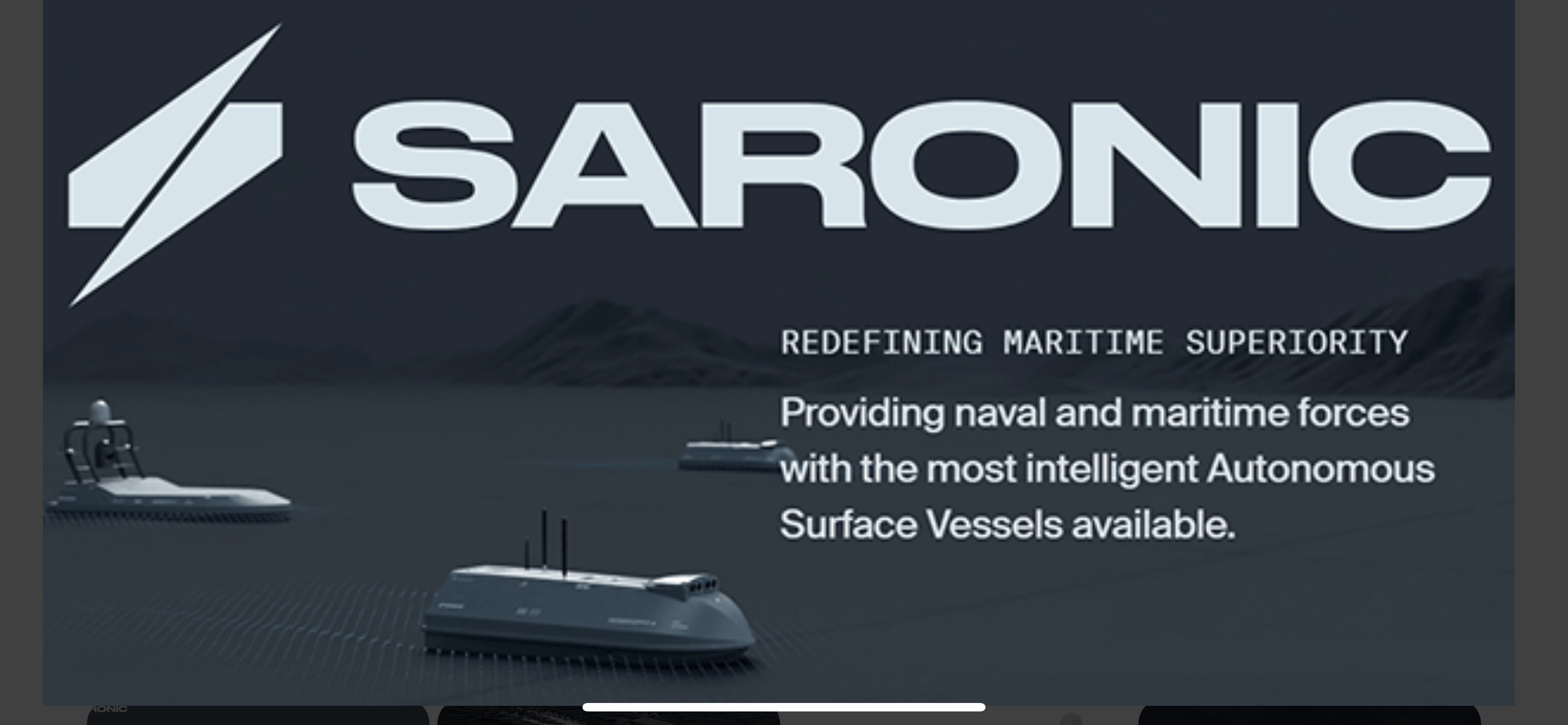
Saronic Technologies
Private Market Spotlight
G.L.A. Invest Research | May 26, 2026 | Coach Kyle

Company Snapshot
Founded | Late 2022 (Austin, TX) |
Stage | Late-stage private / Pre-IPO |
Latest Valuation | $9.25 billion (Series D, March 2026) |
Total Raised | ~$2.6 billion across 5 rounds |
Employees | ~1,500 |
Lead Investors | Kleiner Perkins, Andreessen Horowitz, Bessemer Venture Partners, DFJ Growth, 8VC, Caffeinated Capital, Advent International |
Key Government Contract | $392M U.S. Navy OTA (NAVSEA, through May 2031) |
2025 Revenue (est.) | ~$200M (+1,500% YoY from ~$12.5M in 2024) |

Investment Thesis
Saronic Technologies is building the defining platform for autonomous maritime operations — combining purpose-built unmanned surface vessels (ASVs), vertically integrated manufacturing, and a proprietary AI/ML autonomy stack. The company sits at the intersection of three of the most durable macro tailwinds in the current investment environment: U.S. defense modernization, reshoring of industrial manufacturing, and the commercialization of physical AI robotics.
From a garage in Austin with three co-founders in late 2022, Saronic has scaled to 1,500 employees, a Louisiana shipyard producing four Marauder-class vessels simultaneously, a $9.25B valuation, and a $392M Navy production contract — all in under four years. The pace of execution is exceptional by any standard.
This is not a software company wearing hardware clothing. Saronic has made a deliberate and defensible bet on full vertical integration: designing, manufacturing, and operating its own vessels. That decision creates real moats — proprietary data, cost control, production scalability — and it is the same architecture that made Tesla and SpaceX dominant in their respective categories.

The Product Fleet
Saronic designs and manufactures autonomous surface vessels (ASVs) — unmanned boats and ships purpose-built for robotics, not for human habitation. The fleet currently spans:
Corsair — 24-foot ASV; the workhorse platform. Has logged over 100,000 operational miles. Currently in high-rate production under the Navy contract.
Marauder — 180-foot autonomous ship. Compares functionally to a Field Support Vessel (FSV) or small Offshore Support Vessel (OSV). First hull completed in under six months from facility acquisition. Four hulls currently in simultaneous production in Louisiana.
Future pipeline — Saronic has stated ambitions to scale toward Panamax and Neo-Panamax class vessels (600–1,100+ feet), which would represent one of the most significant expansions in autonomous maritime history.

A critical design insight: because these vessels carry no crew, they eliminate the weight, space, and structural requirements driven by human occupancy — no quarters, no black water systems, no shock/vibration standards for personnel. The Marauder carries 30% more fuel than a comparable manned vessel. As sensor and compute costs commoditize, the unit economics of unmanned vessels will move decisively below manned alternatives.

The Autonomy Stack
Saronic’s technological moat is not its hull — it is the software, AI, and proprietary data that operates the vessel.
The company took a “vision-first” bet analogous to Tesla’s approach in autonomous vehicles: lean into camera-based perception enabled by edge computing. This was only possible because of two macro shifts that Saronic identified early:
Exponential edge compute capability — The processing power available at the vessel level has improved 10x+ year-over-year, enabling real-time AI inference without cloud dependency.
Manufacturing-derived data flywheel — Saronic’s thesis, articulated by co-founder Vib, is that data is the moat, and the best way to get data is to build as many vessels as possible.The more platforms deployed, the more operational data generated, the better the autonomy models become. This flywheel compounds.
Low-Earth orbit satellite connectivity (primarily Starlink, with redundancy from competing constellations) provides a critical command-and-control layer — enabling remote oversight, telemetry, and trust-building with operators — while the heavy compute remains on-vessel due to data volume constraints.
Strategic technology partnerships reinforce the stack:
NVIDIA — Silicon and ML model training for the autonomy platform
Palantir — Production environment data analytics and operations stack
OEM powertrain partners — Deep engineering-level access to engine controls, diagnostics, and valve-level instrumentation to enable unmanned engine room operations
Market Opportunity
The U.S. Navy and allied forces are explicitly moving toward a “hybrid fleet” model — manned warships augmented by autonomous surface and subsurface assets. The strategic logic is clear: ASVs extend force projection, improve domain awareness, and keep personnel out of harm’s way in contested environments (Strait of Hormuz, South China Sea, Arctic routes).
The current $392M Navy contract through 2031 is the first large-scale production agreement in this category. It validates the technology and establishes Saronic as the primary domestic supplier. Prior contracts include:
$26M+ prototype OTA with the Defense Innovation Unit (DIU)
$8M+ prototype agreement with U.S. Special Operations Command
The policy direction is clear. Defense officials are already discussing the concept of a “hybrid fleet” where every destroyer is accompanied by a swarm of Corsairs and Marauders, extending its operational perimeter by 40–50 miles.

Commercial / Offshore Energy
Saronic’s Hornbeck Offshore partnership targets the offshore energy sector — one of the most operationally dangerous and labor-constrained marine environments. The use case is compelling: autonomous OSV-class vessels servicing deepwater rigs, reducing crew exposure, improving utilization rates, and lowering day-rates.
A panel at an industry conference (Sara Week, April 2026) featured a major international oil services company predicting autonomous offshore drilling within 5–7 years. Saronic’s vessels are a prerequisite enabling technology for that future.
Market Size
The global Unmanned Surface Vehicle market was valued at approximately $1.23 billion in 2025, projected to reach $2.03 billion by 2030 at a ~10.5% CAGR. These figures almost certainly understate the true addressable market — they do not account for the displacement of manned commercial shipping, which is a multi-hundred-billion-dollar industry. Saronic’s long-term ambitions in Panamax-class vessels targets that larger prize.
Revenue & Business Model
Saronic generates revenue through four primary channels:
Direct vessel sales — To U.S. Navy, allied militaries, and commercial operators
Government R&D contracts — CRADAs, SBIRs, OTAs with NAVSEA, DIU, SOCOM
Operational services — Deployment and operation of ASV fleets for customers
Data and software licensing — Longer-term monetization layer as the autonomy platform matures
Sacra estimates 2025 revenue of ~$200M, up from ~$12.5M in 2024 — a 1,500% year-over-year increase. This is production-stage revenue, not prototype revenue. The Navy’s $392M contract (with ~$197M already on contract) provides a visible backlog through 2031.
Competitive Advantages
Moat | Description |
|---|---|
Vertical integration | Designs, builds, and operates its own vessels — controls quality, cost, and data |
Proprietary data | 100,000+ Corsair operational miles; growing flywheel that competitors cannot replicate |
First-mover in production | Only U.S. company in high-rate production of Navy-certified ASVs |
Government relationships | Embedded with NAVSEA, DIU, SOCOM — institutional trust is a significant barrier to entry |
Manufacturing infrastructure | Louisiana shipyard producing four 180-ft Marauders simultaneously — capital-intensive and hard to replicate |
Talent & culture | Unique blend of software engineers (Austin) and master craftsmen (Louisiana) — difficult to assemble |
Key Risks
Regulatory / Certification Lag
The USCG, IMO, and ABS are still developing standards for autonomous vessels. Rule cycles are 3–4 years, lagging the pace of innovation. Commercial adoption at scale requires regulatory clarity that does not yet exist.
Technology Trust Gap
Maritime operators have long memories of high-profile incidents (Deepwater Horizon-era parallels). Earning operator trust is a function of logged miles and demonstrated reliability — a process measured in years, not quarters. Saronic estimates it is still in the “bottom of the J-curve” on commercial adoption.
Crew/Labor Disruption Sensitivity
The maritime industry — particularly Gulf Coast port communities — has a deeply ingrained captain/deckhand culture. While Saronic’s message (“the captain runs four vessels instead of one”) is well-received so far, cultural resistance could slow commercial fleet adoption.
Scaling Challenges
Skilled maritime trades labor is already constrained. Scaling production of large-format vessels requires a workforce that is not abundantly available. Saronic is investing in trade schools and wages, but pipeline development is a multi-year effort.
Powertrain / Energy Uncertainty
For vessels above ~275 feet, the optimal energy solution (diesel hybrid, green hydrogen, LNG) is unresolved. Saronic is watching the “Betamax competition” closely. The wrong bet on fuel architecture for large-ship platforms could create costly redesigns.
Valuation vs. Liquidity
At $9.25B, Saronic is priced for execution perfection. There is no current public market exit, and any IPO timeline is speculative. Investors must be comfortable with illiquidity and the risk that government contract cadence dictates growth pace.
Macro Tailwinds
U.S. defense spending shift toward autonomous systems — The DoD is explicitly allocating budget toward unmanned capabilities across all domains
Strait of Hormuz / geopolitical risk — Active maritime conflict zones are the most visible use case for ASVs; ongoing tensions accelerate procurement urgency
Re-industrialization of America — Saronic is a direct beneficiary of reshoring policy; its Louisiana shipyard represents the type of domestic manufacturing investment that receives bipartisan political support
Physical AI / “hard tech” investment cycle — The intersection of robotics, manufacturing, and AI is the defining investment theme of 2024–2028; Saronic is perhaps the purest expression of this in the maritime domain
Starlink / LEO satellite connectivity — Enables real-time command-and-control at sea; coverage expanding rapidly with competing constellations
Comparable Companies
Company | Sector | Stage | Notes |
|---|---|---|---|
Anduril Industries | Defense autonomous systems | Late-stage private | Closest analog — defense tech + vertical integration |
Shield AI | Autonomous military aircraft | Late-stage private | Software-defined defense platform |
Joby Aviation | Autonomous air mobility | Public (JOBY) | Hardware + software + regulatory path parallel |
SpaceX (Starship) | Autonomous space / infra | Private | Vertical integration / manufacturing-as-moat precedent |
L3Harris / Textron | Traditional defense maritime | Public | Incumbents Saronic is displacing |
Conclusion
Saronic Technologies is one of the most compelling pre-IPO investment opportunities in the current defense technology cycle. It is building the physical infrastructure of autonomous maritime warfare and commerce — a category with no dominant incumbent and an addressable market measured in the hundreds of billions of dollars over the next two decades.
The company has done in four years what most defense primes take decades to accomplish: moved from prototype to large-scale Navy production, built a purpose-designed shipyard, assembled a world-class team, and established itself as the default U.S. partner for autonomous surface vessels.


G.L.A. Invest Research — For informational purposes only. Not financial advice. Past performance does not guarantee future results.