G.L.A. INVEST RESEARCH x Coach Kyle
The INFINITE INNOVATION NEWSLETTER— August 2026 Edition
Happy Saturday To G.L.A Nation,
Welcome back to the best newsletter on the planet, where my mission is to keep my network “in the know” with whats really going on with the stock market and its best innovation investments.

If you believe the finance media these days, you would think the sky is falling and every stock is going to zero. Bubble this, Bubble that. Then they trot out Michael burry every 5 minutes to push that narrative a little more. FYI Mr Michael Burry’s hedge fund failed two years ago, yet CNBC still brings him on all the time to scare retail. One of the most important things that retail investors really need to understand is, the finance media is not your friend, not even close. The finance media is paid to keep retail investors emotional. They want you the retail investor to buy and sell (To generate fee’s), they want you the retail investor to be worried when we have a correction, and they want you to be FOMOing when stocks are up. If it bleeds it leads. They also want you the retail investor to think investing is super hard like it’s some sort of wizardry.
That’s where G.L.A INVE$T comes in. Investing is not rocket science, It all comes down to the perspective we have, how we view the market and the strategy we deploy. G.L.A INVEST readers know that the short term market is a voting machine / smoke screen / and just noise, the long term market is a predictable weighing machine that values companies by their fundamentals. I keep hearing and reading articles trying to scare investors that the AI Revolution is 1999 all over again.
Guess what? That narrative is bullshit, and the two names carrying this entire cycle on their backs — Palantir (PLTR) and Nvidia (NVDA) are proving it with their earnings performance.

The Bear Case, and Why It’s Short-Sighted
The loudest bears — Michael Burry among them — have piled bearish options specifically into NVDA and PLTR, arguing valuations have detached from reality. Fair point on the surface: PLTR trades north of 100 times sales, a multiple GMO’s research team flags as genuine bubble territory when compared against historical extremes. But that critique conflates price with quality of earnings, and that’s where the bears get short-sighted.
The dot-com bust happened because ~93% of companies in that boom had no profits and no free cash flow, funded almost entirely by debt — telecom debt growth ran over 187% in five years and capex-to-cash-flow ratios blew past 200%. Today’s AI buildout is the opposite: hyperscalers and leaders like NVDA are self-funding from operating cash flow, with capex consuming a still-manageable share of cash generation rather than borrowed money. That’s the structural difference bears keep skipping past.

PLTR and NVDA Fundamentals: The Real Story
Nvidia trades at a $4.86T market cap and a P/E of 34.4x — elevated, but nowhere near dot-com-era multiples, especially against the earnings growth backing it. Palantir is the more expensive name of the two, carrying a P/E of 129.5x and a market cap of $282.6B — a valuation that demands real execution, and one reason it’s the epicenter of the bear debate.
Metric | PLTR | NVDA |
|---|---|---|
Price | $123.06 | $200.75 |
P/E | 129.5x | 34.4x |
Market Cap | $282.6B | $4.86T |
FY2026 Rev Est | $7.72B | $214.0B |
FY2027 Rev Growth Est | 45.4% | 83.9% |
FY2026 Free Cash Flow Est | $4.33B | $96.0B |
What matters isn’t the sticker price — it’s the trajectory. Nvidia’s consensus revenue is projected to roughly nearly triple from FY2026’s $214.0B to $560.7B by FY2028, with free cash flow already running at $96.0B annually. Palantir’s consensus revenue path runs from $7.72B in FY2026 to $16.0B by FY2028, more than double, with free cash flow accelerating alongside it. Wall Street consensus across the group we track skews heavily bullish at 71.4% of ratings, with an average price target of $189 and highs stretching to $355.
Watch the media linked in this archived editionPALANTIR $PLTR Earnings Monday after the bell-
Palantir reports Q2 2026 earnings Monday, August 3, after the close, with the call at 5:00 PM ET. This is the print that puts the “Anthropic is eating Palantir’s lunch” narrative to bed once and for all.

Why PLTR can’t be disrupted by the models built on top of it
Claude, GPT, and every other frontier model are language engines — they generate text and reasoning, but they don’t own an enterprise’s data, permissions, workflows, or decision infrastructure. That’s Palantir’s ontology layer, and it’s precisely why AIP integrates models from both Anthropic and OpenAI rather than competing with them. Claude sits on top of Palantir, it doesn’t replace it — the model is a component plugged into Palantir’s platform, not a substitute for the platform itself, and the market’s fear here has been fear, uncertainty, and doubt rather than a change in the underlying business.

Palantir’s Q1 2026 print should have already killed this narrative: revenue grew 85% year-over-year to $1.63 billion, with U.S. revenue crossing 100% growth for the first time since its direct listing. U.S. commercial revenue — the segment Anthropic is supposedly cannibalizing — grew 133% year-over-year to $595 million, while commercial customer count rose 42% year-over-year to 615, with 206 deals over $1 million closed in the quarter. Management raised full-year 2026 revenue guidance to $7.650–$7.662 billion (about 71% growth) and lifted U.S. commercial revenue guidance to at least 120% growth, alongside adjusted free cash flow guidance of $4.2–$4.4 billion.

Forget the PE Ratio and Check the Rule of 40, and why chaos is where PLTR thrives
Palantir’s Rule of 40 score — combining growth rate and profit margin — hit 145% in Q1 2026, up from 64% in Q2 2024, blending 85% revenue growth with a 60% adjusted operating margin. That’s not a growth-at-all-costs software story; it’s growth and profitability compounding together, which is exactly why the “Anthropic disruption” bear case struggles to hold up against the tape. Palantir was built for government and defense environments where ambiguity, geopolitical volatility, and fragmented data are the default state — chaos is the product’s home turf, and every macro shock (tariffs, war, AI-arms-race spending) drive’s more urgency into Palantir’s platform.

Energy: The Overlooked Second Leg of This Trade
AI’s real bottleneck isn’t just chip supply anymore, it’s electricity. Goldman Sachs projects US data center power demand doubling from 31 GW in 2025 to 66 GW by 2027, and global data center electricity use is set to exceed 1,000 terawatt-hours by year-end 2026 — roughly Japan’s entire annual consumption. That’s forcing hyperscalers straight into nuclear.
Vistra (VST), trading at $148.19 with a P/E of 24.8x, sits on merchant nuclear and gas generation directly monetizing this demand curve. Oklo (OKLO), at $38.83, is a earlier-stage small modular reactor (SMR) play purpose-built for co-locating power directly at data centers — pre-revenue and volatile, but positioned at the exact chokepoint of this boom. As of May 2026, 13 announced projects have already committed over 9.8 GW of nuclear capacity specifically to AI infrastructure. I Also love $BE (Bloom Energy) ,These are the “picks and shovels” trade layered underneath the chip trade — and it’s still underowned relative to where the demand curve is headed.

This Isn’t 2000
The dot-com bubble was a monument to multiple expansion with almost no earnings behind it — 314% of the Nasdaq tech sector’s ~488% return from 1995-1999 came purely from multiple expansion, versus only 171% from actual earnings growth.Compare that to today: over the 2021-2025 stretch, tech sector returns have been roughly 78% earnings-driven and just 9% multiple expansion. Technology’s share of S&P 500 profits sits near a record ~20%, far closer to its market cap weight than during the dot-com peak, when euphoria wildly outran earnings power.
AI capex (spending) is projected near $800B in 2026 and could exceed $1.12T in 2027, according to Goldman Sachs and Morgan Stanley — the largest capital spending cycle since the 1990s, but this time funded by operating cash flow, not debt. That’s the crux of our long-term thesis at G.L.A. INVEST RESEARCH: we are early in what looks like the largest innovation boom since the early 1900s, spanning compute, robotics, energy, and defense tech, and today’s fundamentals — real revenue, real cash flow, disciplined balance sheets — look structurally nothing like 1999.
The Coach Kyle Bottom Line
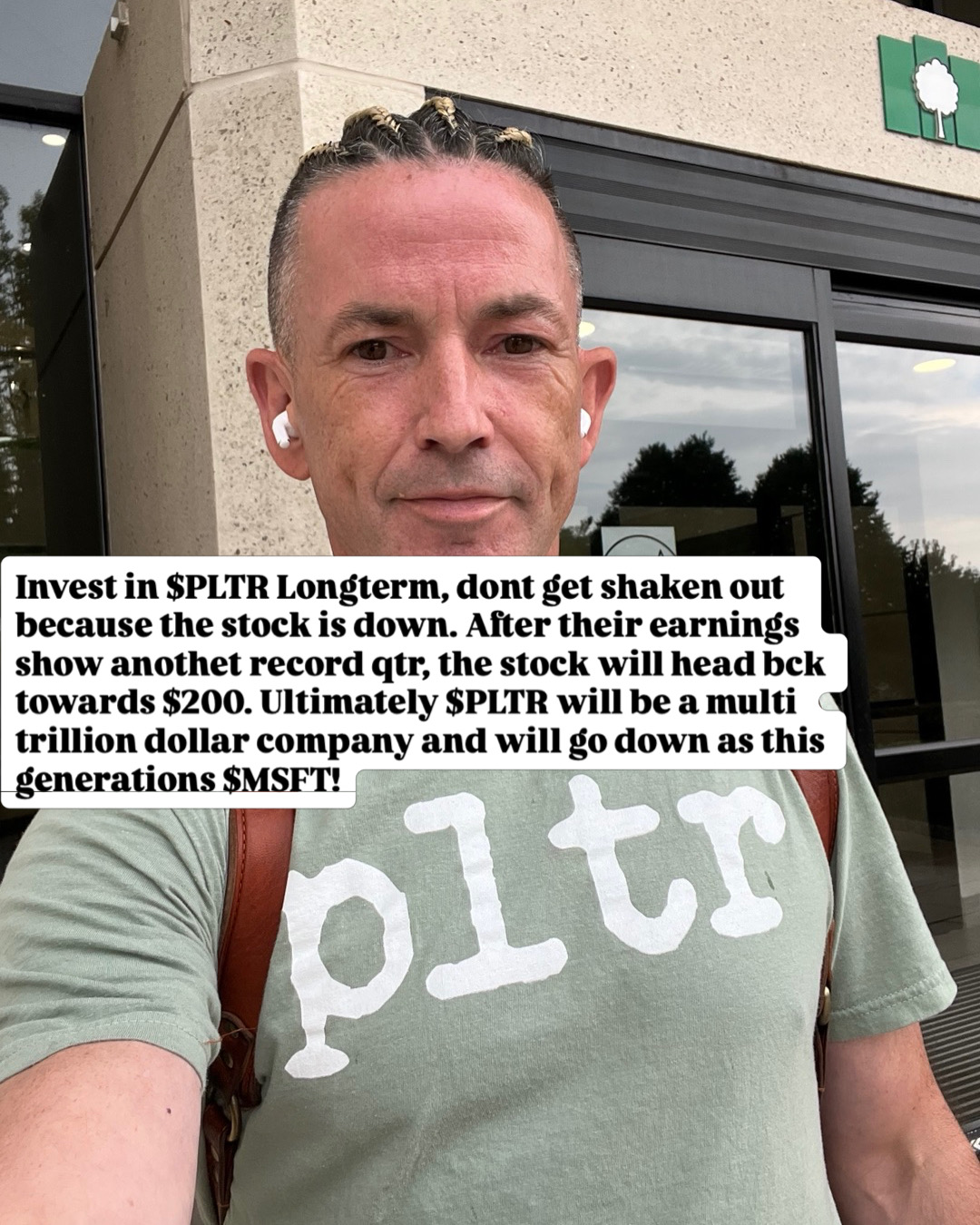
Volatility, sharp pullbacks, and bear raids on names like PLTR and NVDA are part of the ride, not a reason to exit the thesis, and not a reason to panic!We’re positioned as long-term investors in the companies that are changing the world and solving the biggest problems. We do not let the finance media shake our thesis. We let the data tell us what to do and the data is telling us to hold steady and to buy on weakness.
This newsletter is for informational purposes only and does not constitute investment advice. Do your own research , consider your investment objective and time frame.