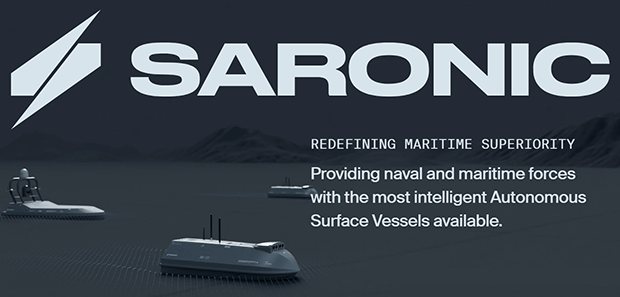
Private Market Stock Spotlight: Saronic
Saronic stands out as one of the most compelling private-market defense technology names for investors tracking the convergence of autonomy, AI, shipbuilding, and national security demand. The company is building autonomous surface vessels for the U.S. Navy and positioning itself as a scaled maritime platform business rather than a single-product defense startup.
Why Saronic matters
Watch the media linked in this archived editionSaronic announced a $600 million Series C in February 2025 at a $4 billion valuation, with the capital earmarked to expand autonomous vessel production and build Port Alpha, a next-generation shipyard for unmanned ships. That matters because the thesis is bigger than selling drones; it is about rebuilding American maritime capacity for an era where hybrid fleets combine crewed ships with large volumes of autonomous vessels.
This is why Saronic can reasonably be framed as the navy’s version of Anduril. Anduril built its brand by aligning cutting-edge autonomy and AI software with urgent U.S. defense needs, and Saronic is attempting the same playbook at sea with autonomous surface vessels, shipyard infrastructure, and software-defined maritime systems.
Watch the media linked in this archived editionInvestment view
From a private-market perspective, Saronic fits the profile of a must-own watchlist name for investors who want exposure to defense autonomy before a potential public listing. The company sits at the intersection of several durable themes: U.S. reindustrialization, naval modernization, autonomous warfare, and rising defense demand tied to great-power competition.
The core bull case is simple:
Saronic is already selling into real defense demand, including Navy work and autonomous vessel programs.
The company is investing in manufacturing scale through Port Alpha, which could become a strategic moat if autonomous shipbuilding becomes a priority category.
Its products align with the Pentagon’s push toward lower-cost, attritable, software-enabled systems that can be deployed faster than traditional shipbuilding programs.
Backers and network effects
The cap table and backer network also strengthen the story. Existing investors include 8VC, the venture firm co-founded by Joe Lonsdale, alongside a16z, Caffeinated Capital, and newer investor General Catalyst.
Joe Lonsdale’s involvement matters for more than signaling value. Lonsdale co-founded Palantir, and his broader defense-tech network has been closely tied to companies and themes built around software, autonomy, and government adoption, including early backing relationships around Anduril and ongoing support for companies serving national security markets.
That connection is notable for investors because Palantir proved that a mission-driven software company can become deeply embedded in U.S. government workflows, while Anduril showed that defense buyers will increasingly fund nontraditional primes that move with startup speed. Saronic appears positioned to pursue the same outcome in the maritime layer of defense.
Watch the media linked in this archived editionGovernment demand
Anduril’s expanding U.S. government footprint helps frame the opportunity set. In 2024, Anduril received a Department of Defense air defense production contract worth nearly $250 million, and in 2026 the U.S. Army awarded Anduril a new enterprise contract to centralize procurement of its commercial technologies while also announcing a broader counter-drone agreement valued at up to $20 billion.
The point for Saronic investors is not that the two companies are identical. It is that Washington is now willing to put major dollars behind fast-moving defense tech firms that deliver autonomy, AI, and deployable systems on compressed timelines, which supports the case that maritime autonomy could become a large procurement lane as well.
What to watch
Investors should watch four signals closely:
Follow-on Navy awards and whether the $392 million Navy contract expands into larger multi-program adoption.
Progress on Port Alpha, because manufacturing scale may become the difference between a promising startup and a category leader.
Evidence that Saronic can move beyond smaller vessels into larger autonomous ship classes without losing speed or margins.
Whether the company continues to attract elite capital and strategic relationships from the Palantir-Anduril defense-tech orbit.
For a investor who is looking to build generational wealth, Saronic checks many of the boxes that matter most: mission-critical product, massive addressable market, alignment with U.S. policy priorities, and investors who understand how to scale defense platforms from niche tools into system-level franchises.
Watch the media linked in this archived editionBREAKING NEWS: Saronic’s Corsair unmanned surface vessel has just made history by rescuing two downed U.S. Army Apache pilots after Iran shot their helicopter down near the Strait of Hormuz, marking the first publicly acknowledged combat search‑and‑rescue at sea carried out by a drone boat.
Watch the media linked in this archived editionWhat Happened
During ongoing U.S.–Iran hostilities, an AH‑64 Apache attack helicopter went down off the coast of Oman, reportedly after being hit by Iranian fire in or near the Strait of Hormuz.maritime-executive+2
U.S. Central Command tasked the Navy’s 5th Fleet and its unmanned‑systems Task Force 59 to execute a rapid recovery of the two‑person crew.defensescoop+2
Instead of sending a traditional crewed rescue craft into contested waters, the Navy deployed a Corsair unmanned surface vessel (USV) built by Saronic to run the primary pickup.axios+2

How Saronic’s Corsair Pulled It Off
The 24‑foot Corsair, operating under U.S. 5th Fleet’s Task Force 59, navigated to the crash area, located the pilots, and recovered them onto its small deck in rough proximity to Iranian forces.
The drone then moved the survivors to another point on the water, where a manned helicopter hoisted them aboard and flew them onward for medical care; CENTCOM says the entire rescue took roughly two hours and both pilots are in stable condition.
This was the first publicly reported instance of an autonomous or remotely operated surface vessel successfully conducting a real‑world personnel recovery at sea, after several years of experimentation with sea drones in the region.

Coach kyle’s 2 cents:IMHO Saronic is a must own for private market investors, especially If you missed out on Anduril, It wouldn’t surprise me to see Anduril Industries acquire Saronic sometime in the next year ahead of their anticipated IPO as Saronic’s “sea drones” would be a perfect fir to add to Andurils maritime division.
