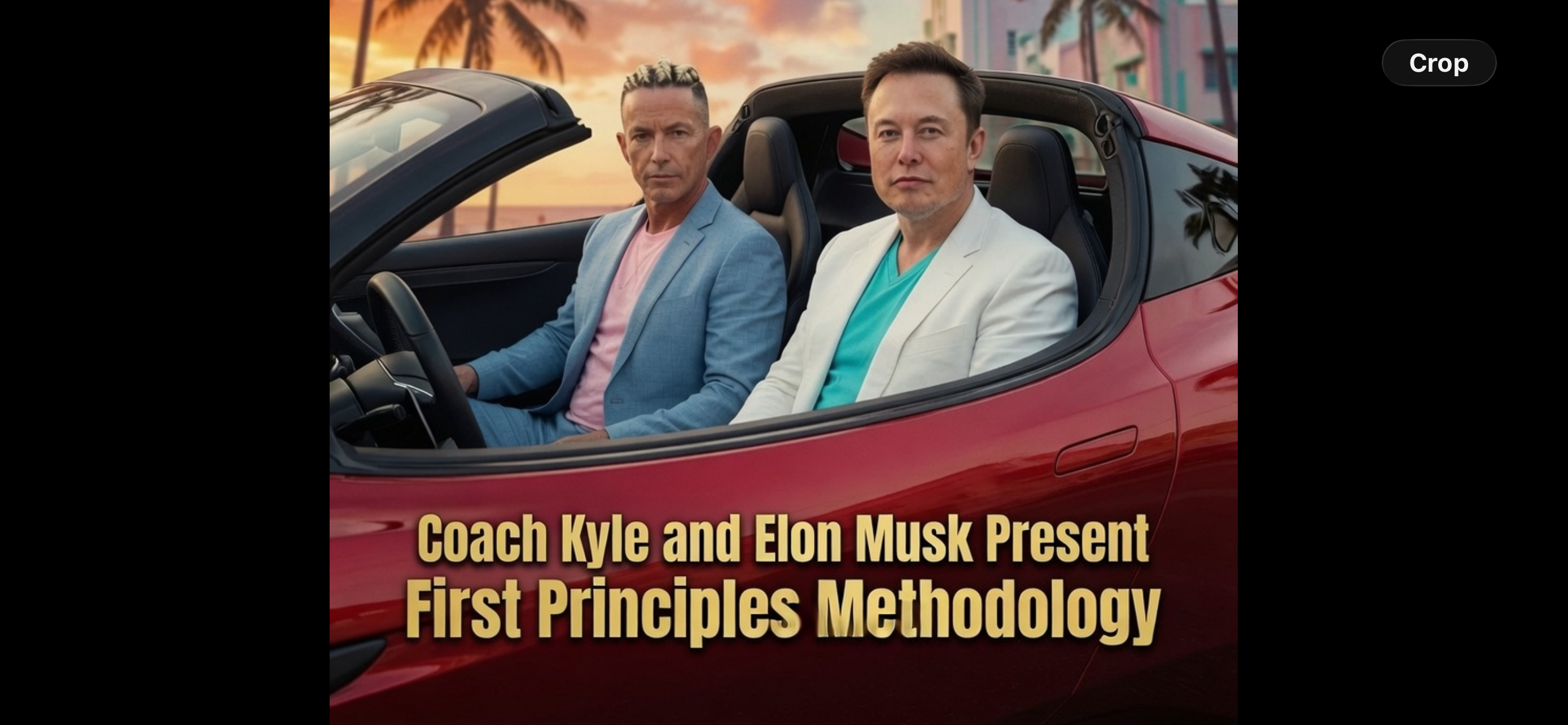
Coach Kyle & G.L.A. INVE$T RESEARCH Present!
The Infinite Innovation Newsletter- “First Principles Edition”

“Boil things down to the most fundamental truths and reason up from there.”
— Elon Musk
Happy Saturday To The Greatest Living American’s Reading This!
Welcome back to the Infinite Innovation Newsletter, where we go beyond the noise, cut through Wall Street’s conventional wisdom, Research and invest from the ground up — not the outside in.

This week, we are doing something special. We are going straight to the source: Elon Musk himself — the most consequential builder of our generation — and dissecting a powerful interview clip where he breaks down his core operating framework. This isn’t just how Musk runs Tesla, SpaceX, and X. It is the exact framework we use at G.L.A. Invest Research to identify world-changing companies before the crowd figures it out.
Let’s dive in.
Watch the media linked in this archived editionWhat Did Elon Musk Actually Say?
Reasoning by Analogy: This is how most people — and most Wall Street analysts — think. “We look at what has been done before, find something similar, and copy it with minor tweaks. “Me too” ideas. Slight iterations on existing themes. It’s mentally easier. It doesn’t require heavy lifting. But it also doesn’t produce breakthrough results.”
Reasoning from First Principles: This is the physics way of looking at the world. You strip everything down to the most fundamental truths — things you know to be absolutely, undeniably true — and then you build your conclusions back up from those foundations. No assumptions. No “that’s how it’s always been done.” Just raw truth and logical construction.
Musk calls this the “physics approach” to problem-solving. Scientists don’t assume. They start with questions: What are we absolutely sure is true? What has actually been proven? They deconstruct problems down to their core pieces and then reconstruct them in a more effective way.

The Battery Story: Elon’s First Principles in Action
Musk gave one of the most powerful and instructive examples of this framework using battery costs.
At the time, the conventional wisdom was clear:“Battery packs are really expensive, and that’s just the way they will always be — because that’s the way they’ve been in the past.”The industry quoted a cost of roughly $600 per kilowatt-hour (kWh).
Reasoning by analogy would accept this as gospel. The history says $600/kWh, so the future says $600/kWh. Done. End of analysis.
But Musk refused to accept the analogy. He applied first principles:
Step 1: What are batteries actually made of? Cobalt, nickel, aluminum, carbon, some polymers for separation, and a steel can.
Step 2: What is the spot market value of those raw materials? He looked at the London Metal Exchange.
Step 3: What is the real floor cost? Approximately $80 per kilowatt-hour.
The gap between $600 (the conventional wisdom price) and $80 (the first principles material cost) told Musk everything he needed to know: brilliant engineering could close that gap dramatically. The battery was not fundamentally expensive — the industry’s way of doing things was expensive. By 2023, electric vehicle battery pack prices had fallen to approximately $128/kWh, a reduction of over 78% from the original $600/kWh baseline.
This is the power of first principles thinking: it lets you see through false ceilings to the true potential hidden underneath. the advantages for investors that use first principles is massive!!

The Horse and the Car: Narrative Kills Innovation
Musk also used a second analogy to explain the danger of reasoning by convention. He described skeptics of the early automobile who said something like: “Nobody wants a car because horses are great — they can eat grass, there’s grass everywhere, and there’s no gasoline to buy. People will never get cars.”
And yet, they were completely wrong.
This is the most dangerous thinking pattern we see in investing today — the incorrect narrative. When the market is anchored to the past, it systematically misprices the future. The skeptics who said horses would always dominate transportation were reasoning by analogy. They had no framework to envision a world where the constraints they assumed (no gasoline, no infrastructure) could be systematically solved.
At G.L.A. Invest Research, we hunt for exactly these situations: companies that Wall Street doesn’t understand, or companies that carry an incorrect narrative that creates a pricing gap between perception and reality. A few perfect examples of this are $MSTR $TSLA $PLTR Bitcoin ect.

If you have any friends that would like to be on our newsletter, please send them our way!!
How We Apply First Principles at G.L.A. Invest Research
Musk’s first principles framework is not just for engineers and builders. It is the most powerful investment research tool available to disciplined, long-horizon investors. Here is exactly how we apply it in our portfolio construction and stock selection process:
1. We Do Not Over-Diversify — We Concentrate in Truth
Modern portfolio theory by analogy says:“Diversify across 50-100 names to reduce risk.”Most advisors follow this because it’s what everyone else has done. WE PUSH BACK HEAVILY ON THIS!
But first principles says: What is the actual purpose of diversification? It is to protect against being wrong. If you have done your homework — if you have truly reasoned from first principles about a company’s fundamentals — then over-diversifying means diluting your best ideas with mediocre ones. As Peter Lynch famously said, all you need is a few big winners — those “ten-bagger” stocks that more than compensate for any mistakes in a portfolio.
At G.L.A. Invest Research, we maintain a small, concentrated group of diversified tech innovation companies — each one truly changing the world, each one stress-tested from the ground up. This is not recklessness. It is the disciplined application of first principles: What do we actually know to be true about these businesses?

2. Visionary Founders and Mission-Driven Companies
First principles thinking is not common. It is rare — which is why the leaders who practice it build companies that others cannot replicate. Elon Musk at Tesla and SpaceX. Jensen Huang at NVIDIA. Jeff Bezos building AWS. These builders don’t copy. They deconstruct, rebuild, and create new realities.
We at G.L.A. Invest Research specifically seek out companies with visionary founders or that are mission-driven at their core. A company with a first-principles-thinking CEO doesn’t just improve the product — they redefine the entire market. This is a durable competitive advantage that balance sheet analysis alone cannot capture.

3. Must-Have Products and Services
From first principles: What makes a product indispensable? Not marketing. Not brand hype. The product must solve a problem so fundamental that removing it would be catastrophic for the customer. High switching costs. Deep integration into how users live and work.
We invest in companies that make must-have products or services — businesses where the customer cannot easily walk away. This is not a subjective judgment call. It shows up in the financial data: low churn rates, strong pricing power, and persistent revenue retention. As Charles Schwab’s research notes, companies with strong switching costs can sustain higher returns on invested capital for the long term.

Fortress balances Sheets that produce huge cash flow.
Fortress Balance Sheets and Free Cash Flow
First principles in finance: What is a business actually worth? At its core, a business is worth the present value of all the free cash flow it generates for its owners, discounted appropriately for risk. Full stop.
Everything else — revenue growth, headline earnings, stock momentum — is secondary to this fundamental truth. A company with a fortress balance sheetand high or rapidly growing free cash flow is a business that cannot be easily killed. It can survive rate cycles, market panics, competitive threats, and macro shocks. It has optionality. It can reinvest at high rates of return to widen its competitive moat.
At G.L.A. Invest Research, every company in our research universe must either demonstrate high free cash flow generation today, or have a clear, believable path to it. We do not invest in stories without structures.

BMNR,OKLO,BE,NVDA,AMD,MRVL,ASTS
5. Massive Total Addressable Markets (TAMs)
Here is where first principles thinking separates serious innovation investors from the crowd. A small company in a massive TAM is potentially a multi-bagger. A large company in a shrinking market is a value trap in disguise.
We ask the first-principles question: How big is the problem this company is solving, at its most fundamental level? Not the analyst’s 3-year estimate. Not the company’s own slide deck projection. What is the true scale of the human need being addressed?
Companies solving trillion-dollar problems — in AI, robotics, defense tech, clean energy, aerospace, and healthcare — have the structural potential to compound for decades. A wide moat in a massive TAM is the closest thing to an investment fortress that exists in public markets.

6. Massive Competitive Moats
The concept of an economic moat is itself a first-principles investing framework. Ask: What stops competitors from simply copying this business and destroying its margins? The answer must be structural, not circumstantial.
Wide moats manifest in four primary ways:
Network effects — The product becomes more valuable as more people use it (think platforms, marketplaces, communication tools)
Switching costs — The cost of leaving is so high — in money, time, or operational disruption — that customers stay even when alternatives exist
Scale advantages — The larger the company gets, the cheaper its unit economics become, making it nearly impossible for smaller competitors to match pricing
Intangible assets — Patents, proprietary technology, regulatory licenses, and brand recognition that cannot be replicated overnight
The presence of a wide economic moat shows up measurably in the financials: sustained high ROIC, stable or expanding gross margins, and persistent market share. These are not soft qualitative factors — they are first-principles truths that you can verify in a spreadsheet.
7. Notable Investors as Signal, Not Substitute

Peter Theil of The Founders Fund / PAYPAL MAFIA / Palantir Founder / Anduril Founder
We pay close attention to investors like Cathie Wood at ARK Invest, Ron Baron at Baron Capital, Peter Theil and Joe Lonsdale Of The Founders Fund and Peter Lynch’s legacy framework — not as a replacement for our own research, but as a signal that our first-principles analysis may be on the right track.
When a world-class, long-horizon investor with decades of experience and deep resources arrives at the same conclusion we have from first principles, that convergence is meaningful. It tells us we are in good company!!
8. Finding the Incorrect Narrative

Michael Saylor $MSTR and Bitcoin are perfect examples of the incorrect narrative.
Some of the greatest investment opportunities of our time have lived inside incorrect narratives — cases where the market’s consensus story was a $600/kWh battery cost disguising an $80/kWh fundamental reality.
When Wall Street says a company is “too expensive,” “too speculative,” or “in a crowded market,” we ask the first-principles question: What do we actually know to be true? Sometimes the market is right. But sometimes — especially in innovation cycles, where analogies from the past are least reliable — the market is anchored to a world that is rapidly becoming obsolete.
These mispriced situations are where patient, first-principles investors generate asymmetric returns.(MSTR,STRC,PLTR,TSLA, are all mis priced.)
Final Thought: The World Belongs to First-Principles Thinkers
The people who said horses were irreplaceable were not stupid. They were reasoning by analogy from everything they had ever known. The people who said batteries would always cost $600/kWh were not incompetent. They were anchored to history.
But history is not destiny. And markets — especially innovation markets — are in constant revolution.
The investors who will win the next decade are not the ones who follow the crowd’s analogies. They are the ones who do the hard, uncomfortable, mentally demanding work of reasoning from first principles — finding the $80/kWh reality inside the $600/kWh narrative — and having the conviction to act on what they discover.
At G.L.A. Invest Research, that is our commitment to you.
Stay curious. Stay concentrated. Invest from the ground up.
— G.L.A. Invest Research | Infinite Innovation Newsletter
*”We invest in companies that are building the future, not describing the past.”*
Disclaimer: This newsletter is for informational and educational purposes only and does not constitute investment advice. All investments involve risk. Past performance is not indicative of future results. G.L.A. Invest Research serves accredited investors. Please conduct your own due diligence.