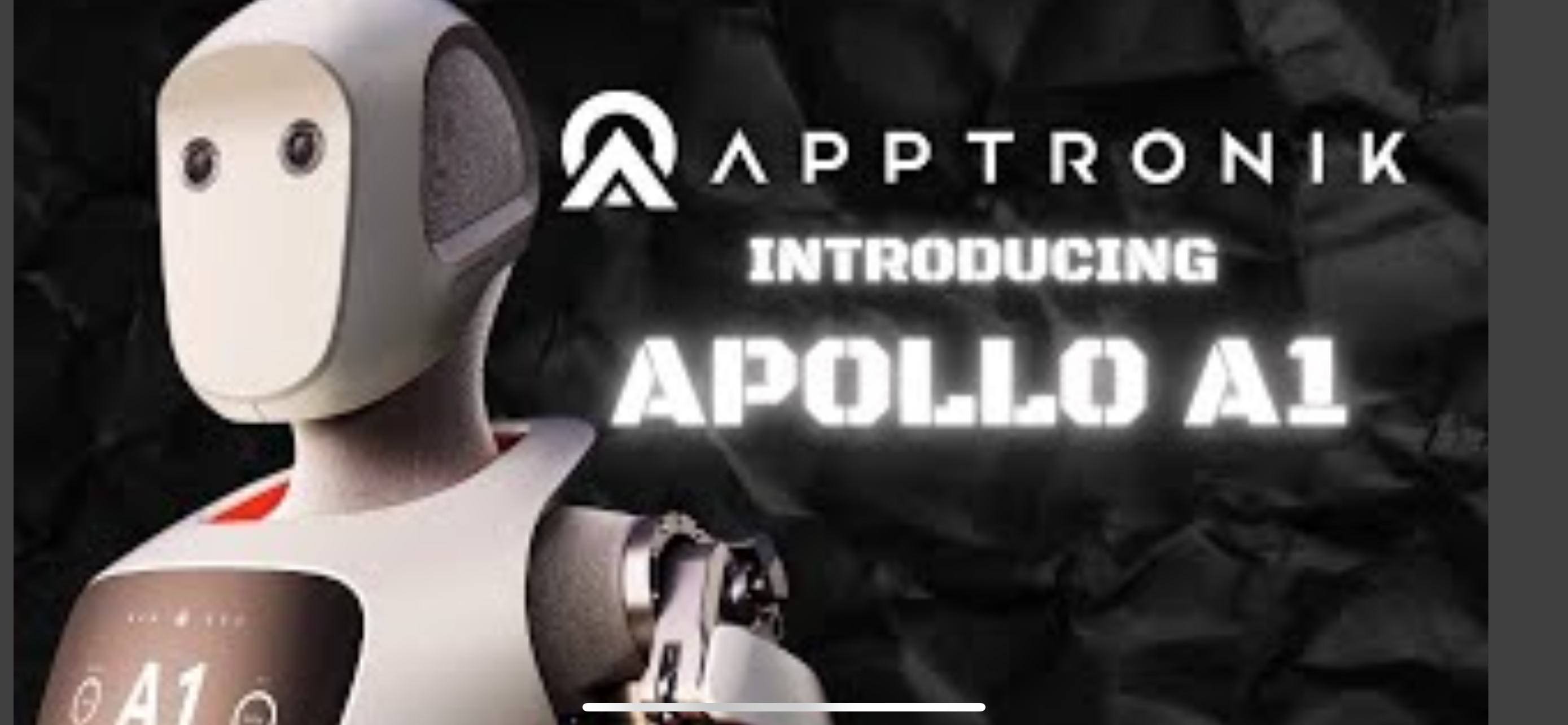
Apptronik and the Rise Of Humanoid Robots.

G.L.A. Invest Research | May 26, 2026 | Coach Kyle
Company Snapshot
Founded | 2016 (Austin, TX — out of UT Austin Human Centered Robotics Lab) |
Stage | Late-stage private / Pre-IPO |
Latest Valuation | ~$5.3–5.5 billion (Series A Extension, February 2026) |
Total Raised | ~$1 billion |
Employees | ~300 |
CEO | Jeff Cardenas (co-founder) |
Lead Investors | Google, B Capital, Mercedes-Benz, PEAK6, AT&T Ventures, John Deere, Qatar Investment Authority, ARK Invest |
Product | Apollo — general-purpose humanoid robot |
Key Partnerships | Google DeepMind (Gemini Robotics), Mercedes-Benz, GXO Logistics, Jabil, NASA |
Target Price Point | Sub-$50,000 BOM (bill of materials) |

Investment Thesis
Apptronik is one of the most credentialed and commercially advanced humanoid robotics companies in the world. With nearly a decade of robotics development — spanning 15+ prior platforms including NASA’s Valkyrie — the Austin-based company has translated deep engineering expertise into a commercially deployable product at the exact moment the market is ready to receive it.
Apollo is not a prototype. It is a general-purpose humanoid robot currently active on the floor of a Mercedes-Benz factory in Berlin and in GXO Logistics warehouses. That distinction — deployed revenue-generating hardware vs. concept stage — separates Apptronik from most of its competitive field.
The broader opportunity is extraordinary. Morgan Stanley projects the humanoid robot market could reach $5 trillion by 2050, driven by labor shortages, aging demographics, and the automation of physically demanding work. Apptronik has three structural advantages that position it to capture a meaningful share: an exclusive AI partnership with Google DeepMind, vertically integrated manufacturing expertise (particularly in actuators — the most expensive robot component), and a proven founder/team with longer robotics experience than most peers.
At a $5.3–5.5B valuation with ~$1B in total capital raised, Apptronik is priced at a steep discount to Figure AI (reportedly seeking a $40B valuation) — making it arguably the most compelling risk-adjusted entry point in the humanoid robotics category.
“I’ve sort of called this the space race of our time.”
— Jeff Cardenas, CEO, Apptronik (WSJ Bold Names Interview)
The Product: Apollo

Apollo is a general-purpose humanoid robot designed to work in environments built for humans — warehouses, factories, logistics centers — without requiring facility modification.
Specs at a Glance
Spec | Apollo |
|---|---|
Height | 5’8″ (173 cm) |
Weight | 160 lbs (73 kg) |
Payload | 55 lbs (25 kg) — highest in class |
Battery Life | 4 hours per hot-swappable pack |
Charging | Hot-swappable OR plug-in / tethered for continuous ops |
Configurations | Bipedal legs, wheels, or fixed pedestal |
Target BOM | Under $50,000 |
Safety | Auto-pause when objects detected in impact radius |
Apollo’s 25 kg payload capacity is 25% higher than Tesla Optimus’s 20 kg target — the highest in its competitive class. Its hot-swappable battery system means zero downtime for recharging, a critical advantage in 24/7 industrial environments.

The robot is Apptronik’s tenth humanoid iteration since 2016. Each prior platform — including the NASA Valkyrie robot — contributed engineering lessons that shaped Apollo’s commercial design. Unlike most competitors who are building their first robot at scale, Apptronik has already made the expensive early-stage mistakes on prior platforms.
A second new robot is slated to debut in 2026, details not yet public.

The AI Stack: Google DeepMind + Gemini Robotics
Apptronik’s most strategically significant asset may not be its hardware — it is the exclusive humanoid platform partnership with Google DeepMind.
Apollo serves as the exclusive humanoid platform for Google’s Gemini Robotics initiative. This means:
Gemini Robotics AI models are trained on and optimized specifically for Apollo hardware
Gemini Robotics On-Device enables on-robot inference — the robot learns new tasks with as few as 50–100 human demonstrations, dramatically reducing deployment friction
Google’s AI compute infrastructure, model training pipelines, and robotics research teams are aligned behind Apollo’s success
This is a structural advantage that compounds over time. The more Apollos deployed in the field, the more real-world training data Google and Apptronik accumulate, and the more capable the Gemini Robotics models become — creating the same data flywheel dynamic seen in autonomous vehicles.
The Google relationship is not just financial (Google led the initial Series A and re-upped in the extension). It is a deep technical partnership that is difficult to replicate. This is Apptronik’s clearest moat.

Commercial Deployments
Apptronik is past the proof-of-concept stage. Apollo has active, real-world deployments:
Partner | Type | Status |
|---|---|---|
Mercedes-Benz | Manufacturing — repetitive intralogistics, component quality tasks at Berlin Digital Factory Campus | Active pilot |
GXO Logistics | Warehouse operations | Early-stage pilot |
Jabil | Electronics manufacturing — sorting, parts handling; also serving as worldwide manufacturing partner for Apollo | Pilot + production |
Mercedes-Benz and GXO represent two of the most economically significant industrial automation use cases globally — automotive manufacturing and third-party logistics. Both are industries with massive, recurring labor demand and well-understood ROI on automation.
The Jabil partnership is particularly noteworthy — Jabil is not only deploying Apollo internally but serving as the worldwide manufacturing partner for Apollo production. This leverages the Texas-Mexico manufacturing corridor for cost efficiency and supply chain resilience, and removes a key scaling bottleneck that has historically constrained hardware robotics companies.

Business Model
Apptronik offers two commercial paths:
1. Robot-as-a-Service (RaaS)
Subscription-based model; customers pay ongoing fees for robot usage. Preferred by logistics companies (3PLs) that want to avoid heavy upfront capex. Aligns Apptronik’s revenue with utilization and outcomes.
2. Capital Purchase
Customers buy Apollo outright. Preferred by manufacturers who treat robots as long-lived capital equipment on their balance sheets.
The dual-model approach is smart — it broadens the addressable customer base and allows Apptronik to capture both the asset-light and asset-heavy segments of enterprise automation.
Additional revenue layers:
Modular architecture creates recurring upgrade and component replacement revenue
Potential software/AI licensing as Gemini Robotics models mature
Longer-term: home and healthcare applications, though this is a 5–10 year horizon per CEO Jeff Cardenas

Funding History
Date | Event | Amount | Cumulative |
|---|---|---|---|
2016–2021 | First 5 years (pre-VC scale) | ~$86M | ~$86M |
Feb 2025 | Series A — led by Google | $350M | ~$436M |
Mar 2025 | Series A upsized | +$53M ($403M total) | ~$489M |
Feb 2026 | Series A Extension — led by Google, B Capital, Mercedes-Benz, PEAK6 | $520M | ~$1B |
The $520M extension in February 2026 was joined by AT&T Ventures, John Deere, and the Qatar Investment Authority — three notable strategic investors that signal commercial expansion into telecommunications infrastructure, agricultural machinery, and sovereign wealth interest from the Gulf region.

The valuation step-up from the initial Series A to the extension was approximately 3x in under a year — reflecting the pace of commercial momentum.
The 3-Stage Deployment Roadmap
CEO Jeff Cardenas laid out a clear, phased vision for Apollo’s commercial rollout in a WSJ interview:
Stage 1 — Industrial Base (NOW)
Controlled environments with expert operators on-site. Logistics and manufacturing. Tasks are discrete, repetitive, and well-defined. This is where Apollo operates today.
Stage 2 — Public-Facing Commercial (3–5 years)
Robots working with and around the general public — retail, healthcare facilities, environments with children and elderly. Higher trust bar required.
Stage 3 — The Home (by ~2035)
CEO’s stated belief: “By 2035 you will see these robots in homes.” Personal assistive care is the ultimate prize — and the original motivation for Cardenas building Apptronik in the first place.
“My dream was: what if you could build a robot to do all the things that humans don’t want to do? What would that free us up to do?”
— Jeff Cardenas
The origin story matters here. Cardenas built Apptronik to solve elder care — watching both his grandfathers lose their dignity in late-stage aging, relying on caregivers for basic needs. That mission-driven founding creates the type of long-duration founder commitment that investor LPs should find reassuring.
Market Opportunity

Near-Term: Industrial Automation
The addressable market for humanoid robots in manufacturing and logistics is enormous. Amazon alone has stated internal plans to automate 75% of operations, potentially avoiding 600,000 incremental hires by 2033. The U.S. faces a structural skilled labor shortage that is projected to worsen with demographics, not improve.
Apollo targets tasks that are:
Repetitive and physically demanding — material handling, sorting, component movement
Dangerous — removing humans from hazardous environments
Labor-constrained — industries that literally cannot find enough workers at any price
Initial target sectors: warehousing, automotive manufacturing, electronics production, logistics.
Medium-term expansion: construction, oil and gas, retail, home delivery.
Long-term: elder care and home assistance — the largest addressable market of all.
Long-Term: The $5 Trillion Horizon
Morgan Stanley estimates the humanoid robot market could reach $5 trillion by 2050 — a number that would make it one of the largest industries ever created. The preconditions are falling hardware costs, improving AI capability, and an aging global workforce. All three trends are accelerating.
Competitive Landscape
Company | Valuation | AI Partner | Status | Key Differentiator |
|---|---|---|---|---|
Apptronik | ~$5.3–5.5B | Google DeepMind (exclusive) | Active Mercedes/GXO deployments | NASA heritage, exclusive Google partnership, proven 10-gen team |
Figure AI | ~$40B (sought) | OpenAI | Early trials with BMW | Highest valuation; least commercially proven |
Tesla Optimus | N/A (internal) | In-house FSD-derived | Internal only; ~10,000 units targeted by end 2026 | Manufacturing scale potential; $20–30K target price |
1X Technologies | ~$1B+ | NVIDIA Project GR00T | Early stage | Norwegian startup; bipedal + wheeled |
Agility Robotics | ~$1B | Amazon (strategic) | Amazon warehouse trials | Amazon-backed; Digit robot; limited product range |
Boston Dynamics | N/A (Hyundai) | Internal | Atlas commercial launch | Strongest locomotion; highest price |
Apptronik’s valuation is dramatically below Figure AI’s reported ask, while being more commercially advanced. The Google DeepMind exclusivity is a differentiator no competitor currently matches.
On Tesla
Cardenas was direct in the WSJ interview:“I think they will be a fierce competitor in this space.” Tesla claims a target of ~10,000 Optimus units by end of 2026, while Apptronik has deployed fewer than 1,000 Apollo units to date. The scale gap is real. However, Tesla Optimus is not available for external commercial purchase — it remains an internal-only platform. The question Cardenas frames as the long-term competitive battle: “What company do you trust? When you start to think about the big markets in the home — these robots have lots of sensors, cameras — what robot do you trust inside of your house?”
The China Threat — In the CEO’s Own Words
Cardenas was unusually candid about China in his WSJ interview, calling it the most important competitive dimension:
“They have manufacturing capacity and the supply chain to move very quickly. They can iterate very fast and we’re already seeing that.”
Key China advantages he identified:
Open standards and data sharing — Chinese companies are open-sourcing models and hardware designs, creating an ecosystem effect vs. the U.S.’s fragmented competitive approach
National robotic strategy — China has committed a 1 trillion yuan (~$138 billion) national fund for robotics R&D and deployment incentives
Demand-side subsidies — The Chinese government is actively paying rebates to companies that purchase domestic robots, artificially accelerating adoption curves
“In the US, we don’t have a national robotic strategy. If we want to be competitive globally, I think robotics will be a key to competing globally in the future.”
This is perhaps the most important policy risk in the report. A U.S. national robotics strategy — if enacted — would be an enormous tailwind for Apptronik specifically, as the most credentialed domestic humanoid company.
Structural Advantages
Advantage | Description |
|---|---|
NASA / 15-platform heritage | No other commercial humanoid company has this depth of prior robotics development |
Google DeepMind exclusivity | Apollo is the sole humanoid platform for Gemini Robotics — an AI partnership that compounds with each deployment |
Actuator expertise | Actuators = 30–40% of robot BOM; Apptronik’s core competency directly addresses the biggest cost driver |
Jabil manufacturing | World-class contract manufacturing partner removes production scaling risk — same model that enabled Apple’s hardware dominance |
Texas-Mexico corridor | Supply chain resilience and cost efficiency without single-source vendor dependency |
Deployed hardware | Generating real-world operational data at Mercedes and GXO today — competitors are still in the lab |
Modular architecture | Legs, wheels, pedestal — broadens deployment scenarios and creates recurring upgrade revenue |
Macro Tailwinds
Structural labor shortage — U.S. and global workforce demographics create sustained, growing demand for automation in physically demanding roles
AI capability acceleration — Gemini Robotics and competing models are improving at a pace that was unthinkable 3 years ago; the gap between demo and deployment is closing
Reshoring of manufacturing — U.S. industrial policy incentivizes domestic automation investment; factories being built now are being designed with robots in mind
Rising labor costs — At $60,000+ annual fully-loaded cost per industrial worker, a sub-$50K robot with a 4-year payback period becomes an obvious ROI calculation
Physical AI investment cycle — The convergence of robotics, manufacturing, and AI is the defining investment theme of the current decade; Apptronik is a direct beneficiary
“The Robots Are Now Learning” — The shift from position-controlled scripted robots to foundation-model AI robots is the core enabling technology change. As Cardenas explained: traditional robots ran a fixed script. Today’s robots learn from watching humans — and because Apollo is human-shaped, it can learn directly from human demonstrations, dramatically accelerating task acquisition
National security imperative — “What is an economy? It’s productivity per person. If you change the number of productive units, you change an economy fundamentally. Robotics will drive national competitiveness and national security in the future.” — Jeff Cardenas. This framing is increasingly resonating in Washington, which creates a potential policy tailwind for U.S. humanoid champions
Summary Scorecard
Dimension | Rating | Notes |
|---|---|---|
Market Opportunity | ★★★★★ | $5T by 2050 per Morgan Stanley; near-term labor economics are already compelling |
Technology / AI Differentiation | ★★★★★ | Exclusive Google DeepMind / Gemini Robotics partnership; 10-gen hardware heritage |
Management / Execution | ★★★★☆ | Deep engineering credentials; commercial scale-up still being proven |
Commercial Traction | ★★★★☆ | Mercedes, GXO, Jabil deployments active — ahead of most peers |
Manufacturing Readiness | ★★★★☆ | Jabil partnership is strong; Apptronik itself is ~300 people |
Competitive Moat | ★★★★☆ | Google exclusivity is powerful; Tesla/China threats are real |
Valuation vs. Peers | ★★★★★ | $5.3–5.5B vs. Figure’s ~$40B ask — dramatically better risk-adjusted entry |
Liquidity / Exit | ★★★☆☆ | No IPO timeline; long-horizon illiquid investment required |
Conclusion
Apptronik is the best-positioned, most capital-efficient, and most commercially credible humanoid robotics company trading at a rational valuation. While the humanoid space is crowded with hype and enormous capital deployments, Apptronik stands apart on three dimensions that matter most: the depth of its engineering pedigree (NASA / 15 prior robots), the exclusivity of its AI partnership (Google DeepMind), and the fact that its robot is actually working on real factory floors generating operational data today.
The company is not cheap at $5.3–5.5B. But relative to Figure AI’s $40B valuation ask with no active commercial deployments, or Tesla Optimus with no external commercial sale timeline, Apptronik offers a compelling combination of de-risked technology, strategic alignment with the world’s most capable AI lab, and real-world commercial validation.
For long-horizon investors building exposure to the physical AI / humanoid robotics theme, Apptronik is a core allocation candidate — arguably the highest quality risk-adjusted entry point in the category available today.

Coach kyle’s 2 Cents: I think Tesla and Apptronic will be amongst the winners in this Race.
G.L.A. Invest Research — For informational purposes only. Not financial advice. Past performance does not guarantee future results.
